
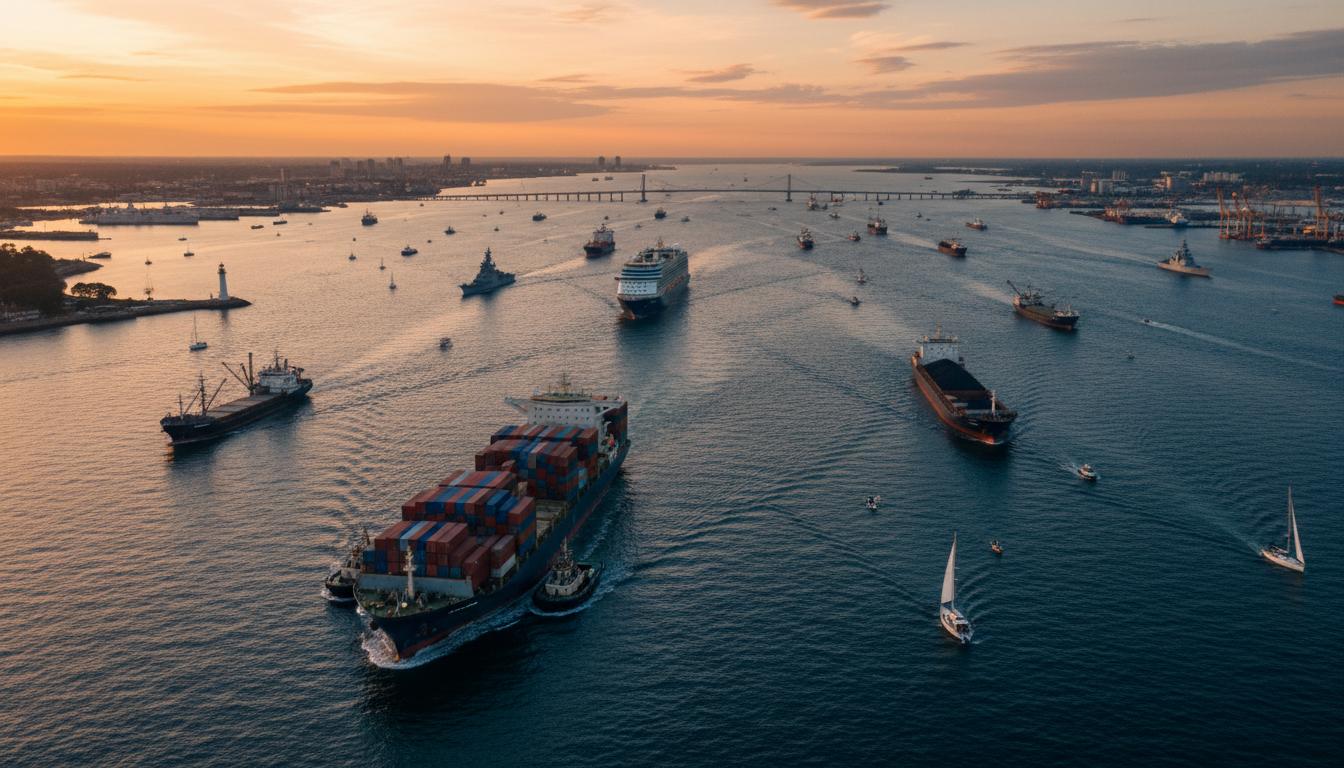
Stand on Canada’s coast—any coast—and you’re looking at a living highway. Tankers off Saint John, container ships sliding past Vancouver, lakers threading the Welland Canal, icebreakers carving leads in Baffin Bay. This is marine traffic: the constant, carefully choreographed movement of vessels that keeps communities supplied and the economy humming. In this guide, you’ll learn how marine traffic works in Canada, how to track ships in real time, what rules keep them safe, and how weather, whales, and ice can change the script. We’ll also show you how marine data can help whether you’re a boater, ship spotter, business planner, or simply curious about what’s happening just beyond the horizon.
What “Marine Traffic” Really Means
Marine traffic isn’t just ships passing in the night. It’s a full ecosystem: navigation infrastructure, coastal radar, vessel tracking technologies, pilotage and port services, ice advisors, and a web of regulations that bind everything together. Think of it as air traffic control meets highway management, with a heavy dose of weather science and maritime tradition.
In Canada, this ecosystem stretches across three oceans, the Great Lakes–St. Lawrence corridor, and thousands of kilometres of inland and coastal waterways. The mix of ships is wide: bulk carriers laden with grain and potash, container ships feeding rail hubs, ferries crossing straits and rivers, cruise ships in season, tug-and-barge combos supplying remote communities, fishing vessels, research ships, and Canadian Coast Guard icebreakers and patrol craft. All of these movements, together, form the picture of marine traffic.
Canada’s Maritime Geography: The Corridors That Shape Traffic
Canada’s shoreline isn’t just long; it’s diverse, and that geography shapes how vessels move.
On the Pacific coast, traffic funnels through Juan de Fuca Strait, Haro Strait and Boundary Pass into the Salish Sea toward the Port of Vancouver and ports on Vancouver Island. Prince Rupert, further north, provides a deep-water gateway with short sailing times to Asia. Strong currents and narrow passes like Seymour Narrows demand precision, tug support, and tight timing.
The Atlantic coast splits into distinct theatres. Halifax anchors the deep-water container and naval presence in Nova Scotia. Saint John sees energy cargoes and forest products. Newfoundland and Labrador’s ports support offshore energy, fishing, and coastal resupply. Farther north, ships skirt sea ice and fog on the Grand Banks and negotiate challenging weather that changes hour by hour.
Quebec and Ontario connect to the Atlantic through the St. Lawrence River and Seaway. From Montreal upstream through the locks to Lake Ontario and beyond, lakers and oceangoing “salties” move bulk cargoes. The Seaway season typically runs from spring to late fall; in winter, many lakers lay up and ocean traffic into the river is shaped by ice conditions, pilotage availability, and draft constraints.
In the Arctic, traffic is seasonal and specialized. Community resupply (the “sealift”) and project cargoes depend on icebreaking support and careful planning between July and October, give or take a few weeks depending on ice. The Northern Canada Vessel Traffic Services Zone Regulations—often referred to through the NORDREG service—govern ship reporting in Arctic waters, helping Canadian authorities manage risks in a region where search and rescue and environmental response are more complex.
How Ships Get Managed: The Framework Behind Marine Traffic
Canada’s marine traffic system blends international standards and domestic rules. Vessels follow the Convention on the International Regulations for Preventing Collisions at Sea (COLREGs), as implemented in Canada’s Collision Regulations under the Canada Shipping Act, 2001. Locally, Vessel Traffic Services (VTS) zones provide mandatory reporting and communication to reduce collision and grounding risks in busy waterways.
The Canadian Coast Guard (CCG) delivers Marine Communications and Traffic Services (MCTS). These centres monitor designated VTS zones, handle distress calls, broadcast navigation warnings, and keep tabs on ship movements. In practice, masters and pilots talk to VTS on VHF radio, follow established traffic lanes (such as Traffic Separation Schemes), and coordinate with tugs and terminals to time arrivals and departures.
In the Arctic, ships report to NORDREG when entering the Northern Canada Vessel Traffic Services Zone. Reporting supports route planning around ice, environmental protection, and emergency readiness. Details on which vessels must report and how reporting works are published by the Coast Guard; anyone planning Arctic operations should check the current requirements well in advance.
Pilotage is another pillar. Four federal Pilotage Authorities—the Atlantic, Laurentian, Great Lakes, and Pacific—manage compulsory pilotage areas where local experts board vessels to guide transits. If you’ve watched a pilot boat nosing up to a moving ship off Halifax or in the First Narrows at Vancouver, you’ve seen pilotage in action. Pilots and masters work as a team, blending local knowledge with the vessel’s characteristics to navigate safely.
AIS and Beyond: The Technology That Lets You See Marine Traffic
Modern ship tracking owes a lot to the Automatic Identification System (AIS). AIS is a VHF radio-based system that broadcasts a vessel’s identity (MMSI, call sign, name), position, speed, course, and other details at regular intervals. Class A transponders are required for most large commercial ships; Class B units are smaller and common on fishing vessels and pleasure craft that choose to transmit. Shore receivers and satellites pick up these signals and feed them to maps and apps you can use on any phone or laptop.
Terrestrial AIS reception depends on line-of-sight. Along Canada’s coasts and on the Great Lakes, a dense network of receivers—public, commercial, and individual hobby stations—provides strong coverage. Satellite AIS closes the gaps offshore and across the Arctic. A Canadian-born pioneer, exactEarth (now part of Spire Global), helped make satellite AIS routine, which is one reason you can watch a ship cross Baffin Bay or the North Atlantic in near real time today.
AIS is only part of the picture. Radar, electronic charts (ENCs), and digital services like navigation warnings support decision-making. For the public, “marine traffic” websites and apps pull together AIS feeds, port call databases, weather overlays, and even predicted routes. They’re not perfect—more on that in a moment—but they’re remarkably useful.
How to Read a Marine Traffic Map Like a Pro
Pull up a live vessel map and you’ll see icons crawling across the screen in different colours and shapes. Here’s how to make sense of it and avoid common mistakes.
Decode the basics
- Icon colour/type: Often shows vessel category (e.g., cargo, tanker, passenger, tug, fishing). Legend varies by platform.
- Vector arrow: Indicates course over ground, not necessarily the ship’s heading. Strong cross-currents may push the course sideways.
- Name and MMSI: Unique identifiers. The MMSI is what radios and AIS use; the name is user-friendly but can change when ships get sold.
Open the vessel card
Click any ship and you’ll see details that explain what it’s doing:
- Speed over ground (SOG) and course over ground (COG): Good proxies for movement. 0 knots doesn’t always mean anchored; it could be moored, drifting, or waiting for a pilot.
- Draught: Reported by the ship. Not always current, but helpful. A fully loaded laker in the Seaway often draws near the allowable limit; a coastal container feeder may draw much less.
- Destination and ETA: Entered by the crew or automated via port systems. Useful, but not gospel. Weather, pilotage slots, and port congestion can change plans.
- Last received: Time since the last AIS signal was picked up. Long gaps may mean the ship is out of range of coastal receivers, or satellite updates are delayed.
Add context
Zooming isn’t enough. Layer in weather, pilot boarding stations, anchorages, and traffic lanes. In Vancouver, for example, you’ll spot anchorages in English Bay and around the Gulf Islands; in Halifax, anchorage areas sit off McNabs Island and in Bedford Basin. On the St. Lawrence near Quebec City, look for significant tidal currents and pilot changes. In the Bay of Fundy, the largest tides in the world can skew a ship’s speed and course dramatically.
Track responsibly
Knowing where ships are is fascinating, but it’s not a game. If you’re on the water, never rely on a phone app as your sole aide to navigation. AIS data can lag, and not every vessel transmits. Always maintain a good lookout, monitor VHF channel 16, and follow the Collision Regulations.
Inside the Control Room: VTS, MCTS, and Navigation Warnings
Imagine being the person who answers a mayday call, coordinates a tanker’s arrival, and warns mariners of a drifting log boom—all within a single shift. That’s MCTS. These centres monitor distress, safety, and routine traffic communications. In designated VTS zones, reporting is mandatory for many vessels, and MCTS officers ensure ships follow procedures designed to prevent close-quarters situations in narrow channels.
Two public information streams matter to anyone following marine movements:
- Navigation Warnings (NAVWARN): Time-sensitive operational messages—think hazards, closed areas, military exercises, buoy outages. NAVWARNs replaced the old “Notices to Shipping” and are issued by the Coast Guard.
- Notices to Mariners (NOTMAR): Monthly updates to charts and publications, issued by the Canadian Hydrographic Service with the Coast Guard. These are the permanent or semi-permanent changes to the marine picture.
Before any major transit—commercial or recreational—Canadian mariners check the relevant NAVWARNs and NOTMAR, then confirm radio procedures and call-in points for the local VTS sector. It’s routine, and it’s one reason Canada’s accident rates in congested waters are low compared to the amount of traffic those waters carry.
Major Canadian Ports and the Traffic They See
Each port has its own signature mix of cargoes and traffic patterns. A quick tour shows how varied marine traffic can be.
| Port/Region | Main Traffic Types | Marine Traffic Highlights |
|---|---|---|
| Vancouver (BC) | Containers, bulk (grain, coal, potash), autos, cruise | Busy anchorages; pilotage through First & Second Narrows; strong currents and bridge air-draft constraints |
| Prince Rupert (BC) | Containers, bulk, wood products | Short Pacific crossing; deep water; growing rail-connected container traffic |
| Halifax (NS) | Containers, RoRo, project cargo, cruise, naval | Year-round deep-water access; approaches managed closely for pilotage and naval operations |
| Saint John (NB) | Energy cargoes, forest products, containers | Bay of Fundy tides; pilotage up the harbour; fog considerations |
| Montreal & Quebec City (QC) | Containers, bulk, cruise (seasonal) | Tidal river navigation; pilot exchanges; seasonal ice management |
| Great Lakes–Seaway ports | Grain, iron ore, steel, cement, salt | Lock scheduling; seasonal closures; Seawaymax vessel limits |
| St. John’s (NL) | Offshore support, fishing, coastal cargoes | Quick weather changes; harbour pilotage; busy with smaller workboats |
Peak times shift with seasons and markets. Grain harvests boost prairie exports through the West Coast and Thunder Bay. Cruise calls spike in the summer. In winter, ice can slow the river and Gulf of St. Lawrence, and Great Lakes shipping pauses around lock maintenance windows. Zooming out, you’ll notice the rhythm of marine traffic is tied closely to rail schedules, commodity cycles, and even the agricultural calendar.
The Great Lakes–St. Lawrence System: Where Lakers Meet Salties
The Seaway is a choreography of locks, speed limits, and dispatching that keeps waterborne trade moving through an inland system shared with the United States. While oceangoing ships call at ports like Hamilton, Toronto, and Thunder Bay during the navigation season, purpose-built “lakers” dominate inter-lake trades. Vessel size is constrained by Seawaymax dimensions—about 225.5 metres in length and 23.8 metres in beam—so vessels are big, but not ocean-megaship big.
Traffic management here is exacting. Lock transits require timing to the minute. Passing windows in narrow reaches are controlled. Winter layup allows for maintenance of both vessels and infrastructure. Ship trackers in Canada often follow favorite lakers by name as they ping-pong between ore docks and steel mills, and it’s one of the most visible, photogenic slices of Canadian marine traffic.
Arctic and Northern Marine Traffic: Short Window, High Stakes
Northern shipping is different. Distances are vast; ice is variable; daylight swings from near-constant sun to long polar nights. Most communities lack road connections, so sealift operations deliver essential fuel, vehicles, and construction materials. Mines and research campaigns bring in specialized vessels. Canadian Coast Guard icebreakers provide routing advice, escorts where needed, and crucial search and rescue readiness.
Before a ship heads north, voyage planning includes reporting to the Northern Canada Vessel Traffic Services Zone (via NORDREG), analyzing Canadian Ice Service charts, lining up local knowledge, and building contingencies for weather delays. The shipping season typically fits within a few months. For the rest of the year, marine movements are sparse and specialized, though satellite AIS and coastal receivers now make even these transits visible to the public in a way that wasn’t possible fifteen years ago.
Environment and Marine Traffic: Speed, Noise, and Emissions
Marine traffic touches sensitive ecosystems, and Canada uses a blend of regulations and incentives to reduce impacts.
Emissions: Canada participates in the North American Emission Control Area under MARPOL Annex VI, which limits sulfur content in fuel used near the coast. Low-sulfur fuel and exhaust after-treatment cut local air pollution around ports and shipping lanes. Shore power (where a ship plugs in at the berth) is expanding at major terminals, trimming emissions during port stays.
Whales: On the Pacific coast, the Vancouver Fraser Port Authority’s Enhancing Cetacean Habitat and Observation (ECHO) Program coordinates voluntary vessel slowdowns in key areas like Haro Strait and Boundary Pass to reduce underwater noise that affects Southern Resident killer whales. On the Atlantic side, measures to protect North Atlantic right whales in the Gulf of St. Lawrence include seasonally adjusted speed restrictions and dynamic management zones. These measures can change each season; ships follow Transport Canada’s directions and NAVWARN updates carefully because the stakes are high for both safety and conservation.
Ballast water: Invasive species are a long-standing Great Lakes concern. Canada enforces ballast water management under the Canada Shipping Act and aligns closely with the IMO Ballast Water Management Convention. Ships trading to Canadian waters must manage ballast to prescribed standards, and there’s close coordination across the Great Lakes with the United States to reduce introduction risks.
Marine Traffic for Boaters: Sharing the Water With Big Ships
Recreational boaters and paddlers are part of the traffic picture, especially around urban harbours and ferry corridors. Sharing space safely with commercial vessels starts with one truth: big ships can’t stop or turn like you can, and they often can’t see you up close.
Practical tips around shipping lanes and ports
- Keep clear of narrow channels when a large vessel is approaching. COLREGs give right of way to vessels constrained by draft in narrow channels.
- Monitor VHF 16 and the local VTS working channel. BC ferries, for example, make security calls at key narrows; commercial vessels do the same in busy corridors across Canada.
- Use AIS as a supplement, not a crutch. Not every boat transmits, and some small commercial or pleasure craft may only receive.
- Understand CPA/TCPA (closest point of approach and time to CPA) if your plotter or app provides it. A small CPA with decreasing TCPA warrants immediate action to make your intentions clear under the rules.
- At night or in fog, give extra room. A ship’s navigation lights or radar target may be the only cue you get until it’s close.
Do you need AIS on a pleasure craft?
Most pleasure craft in Canada are not required to carry AIS. Many choose to carry a Class B AIS transceiver to increase visibility around commercial traffic. If you plan to transmit, you’ll need an MMSI (Maritime Mobile Service Identity) and should consult Innovation, Science and Economic Development Canada (ISED) about ship station licensing and operator certification requirements. Retail pricing for Class B AIS units in Canada varies by features, but many boaters budget in the mid-hundreds to low four figures (CAD) for a transceiver plus installation and antenna work. A receive-only AIS setup is cheaper but won’t make you visible to others.
Either way, integrate AIS display with your chartplotter if possible. Mount antennas correctly (height matters), keep GPS feeds stable, and ensure your MMSI is programmed accurately. Double-check that your vessel name and dimensions are correct in the device’s static data—harbour pilots rely on that information too.
Ferries, Tugs, and Workboats: The Everyday Marine Traffic You See Up Close
Marine traffic in Canada is as much about short-haul service as it is about ocean crossings. Ferries are the lifeblood of many communities. BC Ferries moves people and vehicles between Vancouver Island, the Gulf Islands, and the mainland. Marine Atlantic links Nova Scotia and Newfoundland and Labrador. Dozens of provincial and municipal services cross the St. Lawrence and other rivers daily. On the AIS map, ferries often look like metronomes—back and forth, back and forth—on tight schedules with predictable tracks.
Tugboats and barges are the utility players. They maneuver bulk carriers in harbour, tow fuel and construction materials to remote sites, and support dredging and marine construction. Workboats, pilot boats, and patrol craft make short trips but many per day, creating a fine-grained pattern on any marine traffic map. These vessels operate in close proximity to terminals and navigation hazards, so they communicate constantly on VHF and follow local procedures with an intensity that isn’t always obvious from a casual glance at a tracker.
Using Marine Traffic Data for Work: Practical Use Cases
You don’t have to be at sea to rely on ship movement data. On shore, a growing number of Canadian businesses and agencies weave live and historical marine traffic into their planning.
Logistics and supply chain teams
- Port arrival planning: Knowing when a vessel actually anchors, berths, or clears customs helps rail and trucking teams line up crews, chassis, and railcar slots.
- Dwell and congestion monitoring: A week of elevated anchorage usage in English Bay or off Vancouver Island can signal rail disruptions or terminal backlogs inland.
- Commodity flow analysis: Watching bulk carriers on the St. Lawrence after harvest season, or monitoring potash and grain loadings on the West Coast, informs sales and chartering strategies.
Insurance, compliance, and risk
- Route verification: Did a vessel comply with a seasonal speed restriction for whales? AIS-derived speed profiles can provide evidence.
- Incident reconstruction: Groundings and allisions leave a timestamped track. That trail helps investigators and insurers understand what happened.
Coastal communities and researchers
- Noise and traffic studies: Time series of vessel counts and speeds support marine mammal research and community planning around anchorages.
- Public safety and education: Local groups use map screenshots to explain ferry routes, tug operations, and where small craft should exercise caution.
Accuracy, Gaps, and “Dark” Vessels: Read Marine Traffic Data Critically
Marine traffic platforms look authoritative, but they’re only as good as their inputs.
- Data gaps: Terrestrial receivers can’t see behind mountains or over the horizon. Satellite AIS fills gaps but has its own latency and de-duplication challenges.
- Human-entered data: Destinations and ETAs are often typed in by the crew. Spelling errors and out-of-date entries happen.
- Transponder settings: Draught, dimensions, and call signs may be stale after a yard period or ownership change.
- Privacy and security: Some government and naval vessels restrict what they transmit. Others may switch off AIS when safety or security concerns require it, as permitted by law in specific circumstances.
When accuracy matters—say, for navigational decisions—use official charts and notices, radar, and direct radio communication. For analytics or planning, triangulate multiple data sources and expect a margin of error.
Weather, Ice, and Tide: The Natural Forces That Shape Marine Traffic
Ask any mariner what controls the schedule, and you’ll hear a familiar refrain: weather rules.
On the Pacific, winter lows bring high winds and swell that can close exposed berths and delay pilot boarding. Tidal gates like Seymour Narrows demand transits at slack water. In the Strait of Juan de Fuca, fog banks can roll in fast. On the Atlantic, nor’easters and sea smoke in deep winter, along with heavy icing and drifting sea ice in the Gulf, push schedules around. The Bay of Fundy’s tides—rising and falling more than a dozen metres in places—turn harbour approaches into moving puzzles of current and depth. On the Great Lakes, fall gales and winter freeze-ups are calendar-shaping events.
Canadians plan for this. Environment and Climate Change Canada issues marine forecasts and warnings tailored to coastal and inland waters. The Canadian Ice Service publishes charts and bulletins tracking ice formation, movement, and stage of development. Combining these with live marine traffic views offers a truer picture: you see not just where ships are, but why they’re doing what they do.
Pilotage and Tugs: The Fine Art of Arrivals and Departures
A ship’s arrival at a Canadian port is a team sport. The pilot boards at a designated station—off Victoria for Vancouver traffic, off Chebucto Head for Halifax—and confers with the master. Tugs rendezvous based on ship size, wind, and berth location. Line handlers and terminal crews stand by. VTS grants clearances through narrows or bridges. A gentle ballet follows: quick rudder orders, tug pushes, and careful timing with currents. Reverse the whole thing for departure.
It’s easy to forget from a satellite view how tight this work is. In Vancouver’s First Narrows, air draft under the Lions Gate Bridge, current set, and traffic from multiple directions must align. On the St. Lawrence near Quebec City, tidal windows matter, and pilotage exchanges are slotted into natural pauses. If a strong outflow meets wind and traffic peaks, your marine traffic app may show ships stacking up at anchor. It’s not random; it’s risk management.
Regulations Every Canadian Mariner Knows (or Should)
Understanding marine traffic is easier when you know the rulebook. A non-exhaustive cheat sheet:
- Canada Shipping Act, 2001: The umbrella statute for vessel safety and environmental protection.
- Collision Regulations (COLREGs as applied in Canada): The rules of the road.
- Vessel Traffic Services Zones Regulations and related directives: Define where reporting to VTS is required and what procedures apply.
- Navigation Safety Regulations, 2020: Include requirements related to carriage of navigational equipment, including AIS for certain classes of vessels.
- Northern Canada Vessel Traffic Services Zone Regulations: Establish reporting requirements in Canada’s Arctic waters.
- Ballast Water Regulations: Implement ballast management and control to prevent invasive species introductions.
- Marine Transportation Security Regulations: Establish security levels and requirements for ships and marine facilities.
When in doubt, commercial operators consult Transport Canada Ship Safety Bulletins, port authority notices, and pilotage authority guidelines in addition to internationally recognized standards. Recreational boaters lean on the Transport Canada Safe Boating Guide, Canadian Hydrographic Service charts, and training from accredited course providers.
Costs and Port Calls: What It Takes to Move a Ship In and Out
Moving a vessel through Canadian waters and ports involves predictable but varied costs. While exact numbers depend on vessel size and service providers, most calls include:
- Port authority fees: Harbour dues, berthage, and wharfage based on gross tonnage and time alongside.
- Pilotage: Charged according to regional tariffs and voyage particulars.
- Tugs: Billed based on number, bollard pull, and time on job.
- Lines, stevedores, and terminal charges: Dependent on cargo type and handling.
- Agency services: Local ship agents coordinate everything from pilots to provisions and handle paperwork.
Winter adds complexity. Ice cover can extend transit times, raise tug needs, or prompt scheduling changes to align with icebreaker support and convoy planning. In the Arctic, costs reflect specialized ice-class vessels, shorter navigation windows, and the high premium on self-sufficiency.
Ship Spotting in Canada: Where to Watch and What to Bring
You don’t need to be a mariner to enjoy marine traffic. Canada’s waterfronts offer excellent vantage points where ship movements unfold against big scenery. A few favourites:
- Vancouver: Stanley Park’s Prospect Point for First Narrows transits; Ambleside in West Vancouver for views of English Bay anchorages; Brockton Point for harbour entries.
- Halifax: Point Pleasant Park’s Chain Rock Battery for harbour approaches; the boardwalk for close-up pier views; York Redoubt for a sweeping entrance panorama.
- Montreal & Quebec City: Old Port quays for container ship pass-bys; Promenade Samuel-De Champlain for river traffic with a backdrop of the city and the Île d’Orléans bridge area farther downriver.
- Prince Rupert: Viewpoints along Kaien Island show short pilotage legs in dramatic terrain.
- St. John’s: Signal Hill and the Battery for cliffside views of harbour entries.
Bring binoculars, a windproof layer, and patience. Use a marine traffic app to anticipate arrivals, but be ready for fog or tide delays. Respect private property and safety perimeters, and avoid shining lights or drones near ships and terminals.
From Paper Charts to e-Navigation: The Future of Marine Traffic
The next decade will feel different on the water and on the map. Three shifts to watch:
Smarter voyages
Just-in-time arrivals align ship speed to berth readiness, trimming fuel burn and emissions. Port community systems share data across terminals, pilots, and tugs. Expect more predictable anchorage usage and smoother, less “spiky” marine traffic around busy gateways like Vancouver and Montreal.
Richer data and standards
New S-100 standards for hydrographic data promise more interoperable, dynamic charts. Pair that with satellite AIS advances and better coastal networks, and public maps will show more context, from tides and currents to real-time restrictions. You’ll see fewer “unknown” gaps and more trustworthy predictions.
Greener corridors
Canada’s ports are active in voluntary environmental programs like Green Marine, which drives continuous improvement in air, water, and community impacts. Shore power, alternative fuels, and noise-reduction measures are expanding. Marine traffic won’t vanish, but it will get cleaner, quieter, and better aligned with local expectations.
Common Mistakes When Interpreting Marine Traffic (and How to Avoid Them)
- Assuming a stopped ship is anchored: It might be drifting under control, waiting for a berth, or performing engine tests. Check the status if available.
- Believing ETAs are promises: Think of ETAs as weather-dependent estimates. Watch for changes in speed and course that hint at delays or route adjustments.
- Confusing AIS silence with secrecy: Coverage gaps or equipment issues are more common than intentional shutoffs. Look at the last received time and track history.
- Ignoring context: A sudden speed drop near a pilot station or a narrows is probably procedural, not a problem.
- Using AIS overlays for navigation without cross-checking: On a small boat, you still need charts, visual lookout, radar if available, and VHF.
Step-by-Step: Track a Canadian Voyage From Your Couch
Example 1: Container ship to Vancouver
- Open a live vessel map and filter for container ships.
- Search for traffic converging on Juan de Fuca Strait. Click a ship with destination “Vancouver” or a specific terminal code.
- Note the ETA and speed. If the vessel is offshore, satellite AIS updates may be less frequent; expect the position to jump every hour or so.
- As the ship nears the pilot station off Victoria, updates become more frequent. Watch for the pilot boat’s AIS track approaching.
- Follow the ship through Haro Strait and Boundary Pass. If there’s an active slowdown for whales, you’ll see speeds capped accordingly.
- Near English Bay, the ship may anchor or head directly to a terminal. Tugboats will join for berthing through the narrows.
Example 2: Laker through the Welland Canal
- Filter for cargo vessels in the Great Lakes and zoom on the Welland Canal (between Lakes Ontario and Erie).
- Pick a laker heading northbound. Check its draught and destination—Hamilton, Thunder Bay, or Sault Ste. Marie are common.
- Watch the lock-by-lock progression. AIS will show slow speeds and brief stops as the vessel enters and leaves each chamber.
- Use a separate web cam feed if available to match AIS data with visuals—great for learning how close-quarters handling works.
Safety First: Distress, SAR, and Who to Call
Marine traffic isn’t just commerce. It’s also how rescue assets move. Canada’s Joint Rescue Coordination Centres in Halifax, Trenton, and Victoria coordinate responses to maydays at sea, calling on Canadian Coast Guard vessels, aircraft, and nearby commercial ships. If you’re on the water and need help, VHF channel 16 and Digital Selective Calling (DSC) are the primary lifelines. Offshore, a 406 MHz EPIRB or PLB dramatically improves your odds of a quick response. AIS-based man overboard devices complement, but don’t replace, those tools.
Indigenous Waters and Community Voices
Marine traffic moves through the territories and waters of Indigenous Peoples across Canada. Many projects that increase or shift shipping patterns involve consultation and partnership with First Nations, Inuit, and Métis communities. Concerns range from spill risk and underwater noise to anchorage impacts and archaeological sites. Increasingly, co-management initiatives and Indigenous Guardians programs bring community knowledge into routing, monitoring, and emergency planning. When you follow the movement of ships, you’re also watching a story unfold in shared waters.
Marine Traffic and the Law: Practical Pointers for Non-Lawyers
You don’t need a law degree to stay onside, but a few habits help:
- Use official sources for operational decisions. NAVWARNs, NOTMARs, pilotage rules, and port authority notices are the final word.
- If you transmit AIS, ensure your MMSI and vessel details are correct and authorized.
- Respect restricted areas around naval bases, industrial terminals, and critical infrastructure—even if your map shows an open path.
- When publishing ship position data online (for example, in community groups), consider safety and privacy implications and avoid encouraging risky behavior like drone flights near terminals.
Glossary: Speak the Language of Marine Traffic
- AIS (Automatic Identification System): VHF-based broadcast of vessel identity and movement data.
- MMSI (Maritime Mobile Service Identity): A unique nine-digit number for shipboard radios and AIS.
- VTS (Vessel Traffic Services): Shore-based service that monitors and manages vessel movements in designated zones.
- MCTS (Marine Communications and Traffic Services): Canadian Coast Guard service handling distress, safety communications, and VTS operations.
- NAVWARN: Navigation warnings issued for immediate or time-limited hazards.
- NOTMAR: Notices to Mariners, monthly chart and publication updates.
- Pilotage: Use of a licensed local expert to assist navigating ships in compulsory areas.
- CPA/TCPA: Closest Point of Approach and Time to CPA—metrics for collision risk.
- ENC: Electronic Navigational Chart used in ECDIS and many plotters.
- Seawaymax: Maximum dimensions for vessels in the St. Lawrence Seaway locks.
Agencies and Who Does What in Canada
| Agency/Organization | Role in Marine Traffic |
|---|---|
| Transport Canada | Regulates vessel safety and environmental protection; issues Ship Safety Bulletins; enforces compliance. |
| Canadian Coast Guard | Operates MCTS, icebreaking, aids to navigation, search and rescue, and NAVWARN services. |
| Canadian Hydrographic Service | Publishes nautical charts and Notices to Mariners. |
| Pilotage Authorities (Atlantic, Laurentian, Great Lakes, Pacific) | Provide compulsory pilotage services in designated waters. |
| Port Authorities | Manage port operations, set local procedures and fees, and coordinate with terminals and community stakeholders. |
| Environment and Climate Change Canada | Issues marine weather forecasts; Canadian Ice Service provides ice information. |
Quick-Start Checklist: Smarter Use of Marine Traffic Data
- Define your question first (Where is the ship? When will it arrive? Is there congestion?). Your map clicks will be sharper.
- Verify with two sources for anything that affects safety or money (AIS + port schedule, AIS + NAVWARN, etc.).
- Watch speed trends, not just ETAs. A steady slowdown inland often signals a pilotage window or terminal delay.
- Add weather and tide layers when available. Currents and fog explain a lot of odd tracks.
- Keep a healthy skepticism. The cleaner your inputs (correct vessel identity, current draught), the better your conclusions.
Frequently Asked Questions
Is it legal to track marine traffic in Canada?
Yes. AIS broadcasts are designed to be received by other vessels and shore stations. Many websites and apps lawfully collect and display this information. If you plan to rebroadcast data or use it commercially, check the platform’s terms and applicable privacy and security considerations.
How accurate are the ship positions I see online?
Usually very accurate near the coast where terrestrial receivers are dense. Offshore, satellite updates can introduce delays. Human-entered data like destination and draught can be stale. For safety-critical use, always confirm by radio, radar, and official notices.
Do I need AIS on my boat in Canada?
Most recreational boats are not required to carry AIS. Many choose a Class B transceiver to be seen by commercial traffic. If you install a transmitting unit, you’ll need a valid MMSI and should consult ISED and Transport Canada guidance on licensing and operator certification. Commercial vessels face specific AIS carriage requirements under the Navigation Safety Regulations.
What’s the difference between Class A and Class B AIS?
Class A is mandated for most large commercial vessels. It sends more frequent and detailed updates at higher power. Class B is designed for smaller craft and transmits less frequently at lower power. Many modern Class B units support “CS” and “SO” modes with different transmission methods and performance profiles.
Why did a ship “disappear” from the map?
Common reasons include moving out of range of coastal receivers, gaps in satellite coverage at that moment, equipment issues on the vessel, or intentional suspension of transmissions for safety/security as permitted by law. Check the “last received” time and look again later.
What is VTS, and do all ships have to report?
Vessel Traffic Services are shore-based monitoring and advisory services in designated zones. Reporting rules vary by vessel type and size. Commercial traffic in VTS zones follows mandatory procedures; smaller vessels may not be required to participate but are strongly encouraged to monitor safety channels and stay informed.
How do right whale speed restrictions affect marine traffic?
Seasonal measures in the Gulf of St. Lawrence can set maximum speeds in specific zones, and dynamic areas can be activated when whales are detected. Ships adjust routes and timing to comply. Expect to see reduced speeds and sometimes rerouting on live maps during the management season. Operators check Transport Canada notices and NAVWARNs for the latest instructions.
Can I use marine traffic data for business planning?
Absolutely. Many Canadian firms use AIS-based analytics to track port congestion, estimate arrivals, and monitor commodity flows. Pair AIS with port authority dashboards and weather to improve accuracy.
What is the St. Lawrence Seaway season, and how does it impact traffic?
The Seaway typically operates from spring to late fall, with exact dates announced each year. During the season, lakers and salties move through locks with size limits. In winter, shipping patterns shift, with some vessels laid up and others rerouting via coastal ports.
What should I do if I see a hazard on the water?
Report it on VHF channel 16 to the Coast Guard/MCTS. Provide position, description, and any immediate risks to navigation. Authorities will issue a NAVWARN if appropriate and coordinate a response.
Are there good places to learn more?
Yes. Transport Canada’s website covers regulations and safety guidance. The Canadian Coast Guard posts NAVWARNs and information on MCTS and NORDREG. The Canadian Hydrographic Service provides charts and Notices to Mariners. Environment and Climate Change Canada offers marine forecasts and ice information. Local port authorities publish traffic notices and environmental initiatives.