
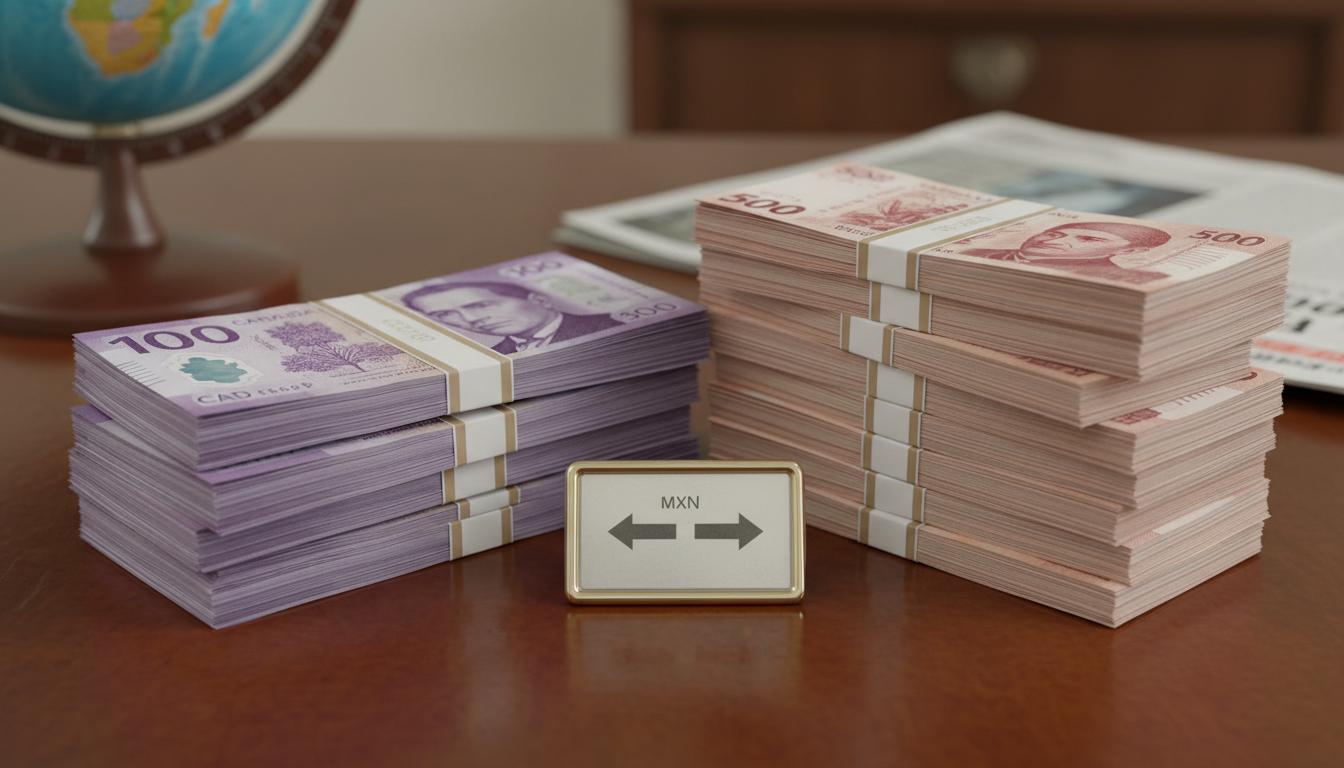
If you’re living in Canada and planning a beach week in Cancún, wiring money to family in Guadalajara, paying a supplier in Monterrey, or wintering in Puerto Vallarta, you’ll hit the same question: what’s the smartest way to handle CAD to MXN? The rate you see on Google is rarely the rate you actually get. Fees hide in the fine print. And timing matters more than most people realize. This guide unpacks everything a Canadian needs to know—how the CAD/MXN exchange rate works, how to cut costs on transfers and card payments, how to avoid common traps like dynamic currency conversion, and which rules and tax considerations apply when pesos meet Canadian dollars.
You’ll find clear explanations, practical checklists, and Canada-specific context—from the way Canadian banks handle international transfers to what the Canada Revenue Agency (CRA) expects when you convert foreign amounts for tax reporting. By the end, you’ll be able to convert CAD to MXN confidently, whether you’re exchanging a few hundred dollars for tacos and cenotes or managing six-figure invoices under a supplier contract.
Understanding the CAD to MXN Exchange Rate
The first thing to know is that there isn’t just one “CAD to MXN rate.” There’s the mid-market rate you see on financial sites, and then there are the retail rates used by banks, currency kiosks, and money transfer services. Those retail rates include markups and fees that change what actually lands in your pocket, on your card statement, or in your recipient’s account in Mexico.
When you search a rate on a finance app—say, “CAD to MXN”—you’re usually looking at the mid-market rate, also called the interbank rate. It’s the midpoint between global buy and sell prices. It’s a fair benchmark, but most consumer services don’t give that rate without any markup. Instead, they add a spread (a percentage margin) and sometimes explicit fees on top.
The different “rates” you’re offered
It helps to separate the headline number from the true cost. Providers present exchange in a few ways:
- Mid-market rate: The raw CAD/MXN benchmark. You’ll see it on XE, OANDA, Reuters, or Google Finance. Consider it your starting reference.
- Retail rate with spread: Many banks and kiosks offer a single rate that already includes their margin. No separate fee line, but the rate is worse than mid-market.
- Mid-market plus transparent fee: Some fintechs show the real mid-market rate, then add a clearly listed fee. You see both components.
- Card conversion rate: Visa and Mastercard set their own daily rates. Your card issuer may then add a foreign transaction fee (often around 2.5%) on the converted amount.
The easiest way to compare is to ask, “How many pesos do I get for my dollars after all costs?” or “How many dollars does my recipient effectively receive when I send MXN?” If a provider can’t show this clearly before you pay, proceed carefully.
What moves the CAD/MXN pair
Exchange rates never sit still. The CAD to MXN rate reflects a mix of economics, policy, and sentiment:
- Interest rates: Policy moves by the Bank of Canada (BoC) and Banco de México (Banxico) shape the appeal of holding each currency. A higher interest rate can strengthen a currency by attracting investment.
- Inflation differentials: If inflation runs hotter in one country, its currency often faces downward pressure over time.
- Commodities and oil: The Canadian dollar is sensitive to commodity cycles, particularly energy. Oil rallies can buoy CAD, all else equal.
- Trade and manufacturing: Canada and Mexico both have deep links with the U.S. economy. Supply chain shifts and trade data can ripple through CAD/MXN.
- Risk appetite: In global “risk-on” periods, investors may seek higher-yielding markets like Mexico; in “risk-off,” they may prefer safer assets. That tug-of-war shows up in the peso.
None of this means you need to forecast markets to buy tacos. But understanding the drivers helps you pick your moments, especially for bigger conversions or business invoices.
Spot, cash, card, and ATM conversions aren’t the same
Even on the same day, you’ll see different CAD to MXN outcomes depending on how you convert:
- Online transfer to a Mexican bank account: Often competitive, especially with services that use the mid-market rate plus a transparent fee. Funds typically arrive same day to 2 business days, depending on method and bank cutoffs.
- Bank wire (SWIFT): Reliable, but may involve sender fees, intermediary bank fees, and a spread on the exchange. Timelines vary from same day to a few business days.
- Cash exchange (Canada or Mexico): Convenient if you need bills, but kiosks and airport counters usually have wider spreads.
- Card purchases in Mexico: Visa/Mastercard rates are generally fair, but many Canadian cards add a foreign transaction fee. Decline any offer to pay in CAD at the terminal (that’s dynamic currency conversion) to avoid a poor rate.
- ATM withdrawal in Mexico: Bank-network rates are reasonable, but you’ll likely face a local ATM fee and your Canadian bank’s foreign transaction fee unless your card specifically waives it.
Bottom line: the “right” method depends on whether you need pesos in cash, prefer the convenience of card payments, or are sending to a bank account. Choose the tool that fits the job rather than forcing every scenario into one method.
Quick CAD to MXN Math You Can Do on the Fly
You don’t need an FX desk to estimate conversions. A couple of mental shortcuts go a long way.
First, grab a current reference rate from a reputable source. Then add a safety margin for the method you’re using. For example, if your Canadian credit card charges a 2.5% foreign transaction fee and Visa’s daily rate is close to mid-market, mentally reduce your purchasing power by about 2.5%. If you’re exchanging at a kiosk, your effective cost could be higher—think in ranges like 3–7% away from the mid-market, sometimes more at airports.
Here’s a simple approach for quick estimates:
- Step 1: Check a live mid-market CAD/MXN (for example only, imagine 1 CAD = 13.00 MXN).
- Step 2: Subtract your expected cost. If you think your total cost is 3%, multiply 13.00 by 0.97 = 12.61 MXN per CAD effective.
- Step 3: Multiply by your dollar amount. CAD 500 x 12.61 ≈ MXN 6,305 effective.
Reverse math works too. If a dinner bill is MXN 1,200 and your effective rate is 12.61 MXN per CAD, you’ll pay about CAD 95. You don’t need it perfect—just close enough to make smart choices, like whether to use a fee-free card or withdraw cash.
All the Ways to Convert CAD to MXN from Canada
Different needs call for different tools. A snowbird staying four months has a different playbook than someone paying a one-off deposit to a hotel or wiring tuition to a university in Mexico City. Here’s how the main options stack up for Canadians.
1) Canadian banks (RBC, TD, Scotiabank, BMO, CIBC, National Bank, and others)
Banks are familiar and secure. If you already bank with a major Canadian institution, you can usually send a wire to a Mexican bank account (in pesos or USD). For a Mexican peso transfer, you’ll typically need the recipient’s full name, address, bank name, branch details if applicable, and their CLABE (Clave Bancaria Estandarizada)—the 18-digit account identifier used in Mexico. Some banks let you set up international payees online; others may require a visit to a branch or a phone call for first-time beneficiaries.
Pros: Strong fraud controls, predictable processes, the ability to speak to a Canadian rep if something goes wrong. For business customers, banks can offer more sophisticated solutions, like forward contracts or multi-currency accounts (usually in major currencies) and batch payments.
Trade-offs: The spread on the CAD to MXN exchange rate is often higher than specialized services, and you may incur both sender fees and fees from intermediary banks. Transfers can take 1–3 business days depending on routing. Always get a quote that shows the final MXN amount after all charges before you commit.
2) Online money transfer services
Fintech platforms have reshaped FX for consumers and small businesses by adding transparency and lowering costs. Well-known names used by Canadians include Wise, Remitly, XE Money Transfer, OFX, WorldRemit, Western Union, and MoneyGram. Each has its own fee model and delivery options—bank deposit in MXN, cash pickup at agents (e.g., OXXO, Elektra, or bank branches), or sometimes delivery to a debit card or mobile wallet in Mexico.
Pros: Often closer to the mid-market CAD/MXN rate, with fees shown upfront. Delivery can be fast (minutes to hours for cash pickup; hours to one business day for bank deposits, depending on method and cutoffs). Many let you set rate alerts and hold a quote for a short period.
Trade-offs: You need to verify your identity (which is standard under Canadian anti–money laundering rules). Fees and limits vary by payment method (debit, bill pay, wire). Always check whether the recipient’s bank participates smoothly with the service—you want a clean path into Mexican accounts, especially when using CLABE numbers.
3) Currency exchange in Canada
If you’d like pesos in-hand before you fly, you can order MXN through your Canadian bank or a reputable currency exchange office. Ordering a few days ahead usually gets you a better rate than walking up at the airport. Smaller branches may need to order in.
Pros: Peace of mind—you land in Mexico with local cash for taxis, tips, or small restaurants that prefer cash. You can comparison-shop rates in your city (Toronto, Vancouver, Montreal, Calgary, Winnipeg, Ottawa, Halifax, and beyond).
Trade-offs: Cash spreads are usually wider than electronic transfers. Airport kiosks tend to be the most expensive because of overhead and captive demand. If you bring a lot of cash, balance safety considerations and border reporting rules for large amounts.
4) Currency exchange in Mexico (casas de cambio)
Exchanging in Mexico can be competitive in tourist areas and city centres, but quality varies. Stick to authorized casas de cambio and banks. Bring your passport; some places require ID for larger amounts. Compare posted buy/sell rates carefully—ask for the final pesos you’ll receive for your Canadian dollars and confirm any extra charges.
Pros: Sometimes better rates than Canadian airports and the flexibility to top up only what you need.
Trade-offs: You’re carrying Canadian cash while you search. Rates fluctuate by location and time of day. Avoid street changers—counterfeit risk isn’t worth it.
5) Debit card ATM withdrawals in Mexico
ATMs are convenient and usually track card-network exchange rates. Use machines at banks (like BBVA, Banorte, Santander, Citibanamex, or Scotiabank Mexico) instead of standalone kiosks to reduce tampering risks. Always decline any on-screen offer to convert the transaction to CAD; that “dynamic currency conversion” typically adds a steep markup. Choose “chequing” or “savings” if prompted; “credit” can fail for debit cards.
Pros: Easy access to pesos as you need them. Card-network rates (Visa/Mastercard) are generally competitive compared to tourist kiosks.
Trade-offs: Expect a local ATM fee and possibly a foreign transaction fee from your Canadian bank. If your bank is part of a global alliance (for example, Scotiabank and the Global ATM Alliance), you may reduce or avoid certain ATM surcharges at partner banks—though a separate card FX fee may still apply. Check your card’s terms carefully before you go.
6) Credit cards and prepaid travel cards
For many Canadians, a good travel credit card is the simplest way to handle day-to-day spending in Mexico. Visa and Mastercard are widely accepted in cities and tourist areas. American Express has patchier acceptance outside high-end merchants. Contactless is increasingly common, but carry a chip-and-PIN card as backup.
Watch out for two things: foreign transaction fees and dynamic currency conversion. Many Canadian credit cards charge about 2.5% on foreign-currency purchases. A smaller set of cards waive this fee. Examples have included the Scotiabank Passport Visa Infinite and the Home Trust Preferred Visa, which historically waived foreign transaction fees—always confirm current terms directly with the issuer before you apply or travel. With any card, if a terminal asks whether to bill you in CAD or MXN, choose pesos (MXN). Billing in CAD at the point of sale (DCC) almost always costs more.
Prepaid travel cards offer budgeting control and sometimes multi-currency features, but check their fee schedule: load fees, FX markups, ATM fees, and inactivity charges vary. Make sure they support Mexican pesos directly or convert at competitive rates.
7) Remitting money to family or friends in Mexico
Sending CAD to MXN for family support is common among Canadians with ties to Mexico. Your main choices: bank deposit in MXN using a CLABE, cash pickup at agents across Mexico, or deposit to a debit card. Speed, cost, and convenience often favour specialized remittance services over traditional bank wires for small to mid-size amounts.
Check:
– Your payment method (debit, direct debit from your Canadian bank, or wire) and how it affects fees.
– Pickup networks near your recipient if you choose cash pickup.
– Receiving limits and ID requirements in Mexico.
– Daily and monthly caps—compliance checks are normal under Canadian and Mexican regulations.
What Really Determines Your Effective CAD to MXN Rate
It’s not just the number on the screen. Several moving parts change the final pesos you or your recipient see.
Exchange rate spread (markup)
Many providers post a single rate that looks neat but hides a spread. For example, if the mid-market rate is 1 CAD = 13.00 MXN and a provider offers 12.55, the 3.5% gap is their margin. Another provider might show the true rate and charge a CAD fee instead. Either way, compare the final MXN outcome per dollar, not just the format of the pricing.
Transfer and network fees
Bank wires can involve sender fees and sometimes fees skimmed by intermediary banks (especially on USD legs). Money transfer services may charge a small flat fee or a percentage. Debit and credit networks price exchanges daily and card issuers can add foreign transaction fees. ATMs layer on local machine fees and potentially your bank’s international withdrawal fees.
Dynamic currency conversion (DCC)
This one trips up travellers everywhere. A terminal or ATM offers to bill you in CAD “for convenience.” In reality, it routes the exchange through the merchant’s or ATM operator’s rate, which is commonly much worse. Always choose to pay in pesos (MXN) in Mexico to keep the conversion on Visa/Mastercard rails and avoid an extra, avoidable markup.
Timing and market movement
Rates move all day during the workweek and can gap after major news or on Monday open. Some services lock a quote for minutes or hours; others re-price until you fund. If you’re converting a larger amount, it can be worth watching the CAD/MXN rate for a few days and setting a rate alert.
Illustrative example of all-in cost
The numbers below are for illustration only, using a hypothetical mid-market of 1 CAD = 13.00 MXN to show how markups and fees change outcomes on CAD 1,000.
| Method | Pricing style | Assumed cost | Peso outcome (hypothetical) |
|---|---|---|---|
| Fintech transfer | Mid-market + fee | 1.0% total | ~12,870 MXN |
| Bank wire | Spread + fee | 2.5% total | ~12,675 MXN |
| Credit card purchase | Card rate + FX fee | 2.5% FX fee | ~12,675 MXN value |
| Airport cash kiosk | Included spread | 5–8% total | ~11,960–12,350 MXN |
Again, these are sample figures to show the mechanics, not quotes. Real numbers vary by provider and day.
When Is the Best Time to Convert CAD to MXN?
No one times FX perfectly, but you can make the odds kinder.
Use alerts and watch trends, not noise
Set rate alerts on reliable apps and glance at the CAD/MXN trend over a few weeks. If the peso has strengthened quickly, you might split your conversion into two or three tranches instead of all at once. If CAD is having a strong week, you might convert a bit more to lock in value for near-term expenses.
Weekdays beat weekends for pricing transparency
Foreign exchange markets operate 24 hours on business days. On weekends, many services “freeze” rates with wider cushions. If you can, convert or fund transfers Monday to Friday during market hours for tighter spreads.
For larger amounts, consider hedging tools
Businesses and high-value remittances can justify using forward contracts or limit orders through a bank or an FX specialist. A forward locks a CAD to MXN rate for a future date, protecting your budget. A limit order triggers a conversion only if the market reaches your target rate. These tools come with requirements and risks—speak to a provider who’ll explain margin, settlement, and cancellation rules in plain language.
Avoid last-minute airport exchanges
If you like savings, don’t leave cash needs to the airport. Order pesos from your Canadian bank in advance or use a reputable exchange downtown. In Mexico, withdraw from a bank ATM upon arrival if you’re comfortable with card fees and security best practices.
Practical Playbooks for Common Canadian Scenarios
A week in Cancún or Los Cabos: cards first, cash for small spots
For short trips, a no-foreign-transaction-fee credit card is your easiest primary payment method. It tracks the card-network CAD/MXN rate and avoids the ~2.5% many cards charge. Always pay in pesos at the terminal. Carry some cash for colectivos, street food, markets, and tips. Withdraw at a bank ATM (inside a branch, if possible) and decline any on-screen conversion to CAD. Keep small bills—MXN 20, 50, and 100 notes go a long way.
Hotel holds and car rentals can place temporary authorizations on your card. If you’re using a debit card, those holds reduce your available funds longer than you expect. A credit card is generally better for deposits and incidentals.
Snowbirding in Puerto Vallarta or Mérida: keep fees predictable
If you’re in Mexico for months, steady, low-friction access to MXN matters. Mix methods: a fee-free credit card for daily spend; ATM withdrawals at partner banks if your institution offers any surcharge waivers; and an online transfer service for larger monthly expenses like rent. For recurring transfers to a landlord’s Mexican bank, test a small deposit first to confirm the CLABE and recipient name exactly match.
Consider online bill pay arrangements if your landlord or utility provider supports it. If your condo building or property manager prefers USD, clarify whether you or they will convert USD to MXN, and at which reference rate and day each month to avoid disputes.
Canadian student in Mexico City: budget with buffers
Between tuition, transit cards, textbooks, and weekend travel, student budgets stretch best when FX costs are low and predictable. Many students do well with:
– A primary no-FX-fee credit card for tap payments and online purchases in pesos.
– A secondary debit card for cash withdrawals, ideally from a bank with fair international terms.
– A trusted transfer service to move CAD to MXN in your own Mexican bank account if you open one (some universities help students set up local accounts).
Tell your bank you’re studying abroad, enable transaction alerts, and store bank contact numbers. Back up essential documents and disable contactless on a card if it worries you.
Paying a supplier in Monterrey: protect your margin
If you’re a Canadian business importing from Mexico under CUSMA/USMCA, currency swings can quietly clip your profit. Ask your bank or FX provider about:
– Forward contracts to lock the CAD/MXN rate on upcoming invoices.
– Batch payments if you pay multiple vendors—fees often drop when you consolidate.
– Whether your supplier can invoice in CAD or USD and what that does to pricing.
On the tax side, the CRA typically accepts Bank of Canada exchange rates for converting foreign-currency amounts on your books. Many businesses use the daily rate on the transaction date or the Bank of Canada’s monthly/annual average for reporting, depending on the context. Document your source and method consistently.
Sending support to family in Guadalajara: prioritize reliability and pickup convenience
For remittances to loved ones, reliability and convenience outrank shaving an extra tenth of a percent. Confirm:
– Preferred delivery method: bank deposit to a CLABE, cash pickup, or deposit to a card.
– Nearest and safest pickup locations and hours if choosing cash.
– ID requirements for your recipient in Mexico (usually government-issued photo ID; name must match your transfer exactly).
Set SMS or email notifications so you and your recipient know when the MXN funds arrive. For regular support, consider scheduling monthly transfers at a time that lines up with your income—consistency reduces stress on both sides.
Rules, Limits, and Paperwork Canadians Should Know
Cross-border money movement triggers regulatory checks. Good news: compliance is manageable once you know what to expect.
FINTRAC and anti–money laundering requirements
In Canada, financial institutions and money services businesses must comply with the Proceeds of Crime (Money Laundering) and Terrorist Financing Act. Practically, that means identity verification, recordkeeping, and reporting certain transactions. If you send international electronic funds transfers of CAD 10,000 or more (in a single transaction or multiple within 24 hours that total that amount), your provider may have to report them to FINTRAC. Structured transactions aimed at avoiding thresholds can trigger reviews. Don’t be surprised if you’re asked for the purpose of funds or the source of funds on larger transfers—this is normal.
Carrying cash across borders
Bringing travel cash? Canada requires you to declare if you’re entering or leaving with currency or monetary instruments totaling CAD 10,000 or more (or the equivalent in foreign currency). You’ll make the declaration with the Canada Border Services Agency (CBSA). Mexico has a similar requirement: declare if you enter or leave with more than the equivalent of USD 10,000 in cash or monetary instruments. You can legally carry more than these thresholds, but you must declare it. Failing to declare can lead to seizures and penalties.
Tax basics when currencies are involved (personal and business)
For most travellers, buying a few thousand pesos and spending them on meals, attractions, and taxis has no Canadian tax consequence. But two points are worth knowing:
- Foreign exchange gains on personal-use funds: If you hold foreign cash for personal use and the gain or loss from small, day-to-day transactions is minor, it’s typically ignored. However, if you treat foreign currency as an investment or hold larger balances, currency gains may be taxable as capital gains.
- CRA exchange rates: When you need to convert foreign amounts for tax reporting (say, business expenses paid in MXN), the CRA generally accepts Bank of Canada exchange rates. Businesses often use the rate on the date of the transaction or the Bank of Canada’s monthly or annual average, depending on policy. Keep consistent records and cite your source.
If you own foreign assets, be aware of the T1135 Foreign Income Verification Statement if your specified foreign property exceeds CAD 100,000 in cost. This is separate from travel money but becomes relevant if you hold foreign financial accounts or certain investments tied to Mexico. When in doubt, speak with a Canadian tax professional.
Customs valuation and invoices under CUSMA/USMCA
Importing goods from Mexico? Duty relief under CUSMA may apply when rules of origin are met, but GST/HST and other taxes can still be due. The currency you use to pay a supplier doesn’t change your Canadian tax liability, but you’ll convert invoice amounts to CAD for your books and for customs declarations using accepted exchange rates. Consistent, well-documented conversion practices reduce audit headaches.
Reading and Using Official CAD/MXN Rates
For a personal trip, any reputable live rate source is fine. For accounting and tax, use sources the CRA recognizes and document them in your files.
Two reliable references:
– Bank of Canada: Provides daily and average exchange rates used widely for Canadian tax and accounting conversions. If you can’t find a direct CAD/MXN posting for a particular period, your accountant may convert via a cross-rate (e.g., CAD/USD and USD/MXN) and document the method.
– Banco de México (Banxico): Publishes official reference rates in Mexico, including the FIX rate used in some legal and accounting contexts in Mexico. This is more relevant to Mexican entities, but helpful when reconciling amounts with partners there.
Whatever you choose, be consistent—use the same reference source and methodology for similar transactions and keep copies or screenshots for your records.
Safety, Fraud, and Travel Money Tips in Mexico
Millions of Canadians visit Mexico safely every year. A few practical steps keep your CAD to MXN experience smooth.
Guard your cards and pick good ATMs
Use ATMs located inside bank branches or reputable malls. Cover the keypad, tug on the card reader before inserting your card, and decline any conversion to CAD. Keep your bank’s international contact number handy and enable real-time transaction alerts via your mobile banking app.
Use pesos at point of sale
If a waiter or cashier offers to run your card in Canadian dollars, it’s almost certainly more expensive than paying in pesos. Ask to be charged in MXN and verify the amount on the terminal before you enter your PIN. Keep the merchant copy of the receipt until the transaction clears on your statement at the expected CAD equivalent.
Cash handling and change
Carry small bills for taxis, mercados, and tips. Many shops can’t break large notes easily. If you receive change, glance at the bills to ensure denominations are correct. Counterfeiting risk is lower when you withdraw from bank ATMs or exchange at authorized casas de cambio.
Wi‑Fi and account safety
Avoid logging in to your bank or transfer service over public Wi‑Fi without a VPN. Use strong, unique passwords and two-factor authentication. If you lose your phone or card, freeze access from your app and call your bank promptly.
Tools Canadians Can Trust for CAD to MXN
Comparing providers is easier when you’ve got a short list of reliable names and official references.
- Rate trackers: XE, OANDA, Google Finance for quick CAD/MXN checks and alerts.
- Money transfer services: Wise, Remitly, XE Money Transfer, OFX, WorldRemit, Western Union, MoneyGram. Compare delivery speed, total cost, and recipient options.
- Canadian banks: RBC, TD, Scotiabank, BMO, CIBC, National Bank—use for wires, larger sums, and when you need branch support.
- Official sources: Bank of Canada (for tax/reporting conversions), Banxico (reference rates in Mexico), CRA, CBSA, and FINTRAC (for rules and guidance).
Before committing, get two live quotes for the same CAD amount—one from your bank and one from a specialist. Look at the final MXN number after all fees. The better value often jumps out.
Comparing Your Options at a Glance
Use this table as a directional guide when deciding how to convert CAD to MXN. Actual pricing varies by provider, time, and amount.
| Option | Typical total cost | Speed | Best for | Notes |
|---|---|---|---|---|
| Online transfer (bank deposit) | Low to moderate | Minutes to 2 business days | Remittances, rent, tuition | Often close to mid-market plus a clear fee |
| Bank wire | Moderate | Same day to 3 business days | Large sums, business payments | Check for intermediary fees and spreads |
| Credit card purchase | Low to moderate | Instant | Travel spending | Avoid DCC; consider a no-FX-fee card |
| ATM withdrawal | Moderate | Instant | Cash needs | Use bank ATMs; expect local ATM fees |
| Cash exchange (Canada) | Moderate to high | Same day (if in stock) | Small starter cash | Order ahead; avoid airport counters |
| Cash exchange (Mexico) | Moderate | Same day | Top-ups during trip | Use authorized casas de cambio |
Step-by-Step Checklists
Before you fly from Canada to Mexico
- Pick your primary card for travel. If possible, choose one that waives foreign transaction fees.
- Notify your bank of travel dates. Enable transaction alerts and add your bank’s international phone numbers to your contacts.
- Order a small amount of MXN cash from your bank or plan to withdraw from a bank ATM upon arrival.
- Download a reputable rate app and set a CAD/MXN alert.
- Photocopy your passport and cards; store securely separate from the originals.
Sending CAD to MXN for the first time
- Gather recipient details: full name as on ID, bank name, branch if needed, and the 18-digit CLABE for bank deposits.
- Compare at least two providers for the same CAD amount. Check the final MXN after all fees.
- Send a small test transfer to confirm details. Verify arrival time and exact pesos delivered.
- Save confirmation numbers and screenshots of the quoted rate and fees.
- Scale up once you’re confident everything matches.
Paying a Mexican invoice as a Canadian business
- Agree in writing on currency (MXN, CAD, or USD), payment due date, and reference rate if applicable.
- Decide whether to hedge using a forward or limit order if amounts are material to your margin.
- Choose the payment rail (wire vs specialist) based on total cost and reliability.
- Record the transaction date, exchange rate source, and conversion method for your books.
- Review CUSMA paperwork and customs valuation rules if goods cross the border.
Common Mistakes Canadians Make—and Easy Fixes
Everyone learns these the hard way at least once. You don’t have to.
- Accepting dynamic currency conversion: Always choose to pay in MXN at terminals and ATMs.
- Converting at the airport: Order cash in advance or use ATMs at bank branches instead.
- Ignoring fees because the rate “looks good”: Ask for the final MXN after all costs.
- Sending a large first transfer without a test: Start small to confirm the CLABE and recipient name.
- Using a debit card for car rental holds: Use a credit card to avoid tying up your chequing funds.
- Forgetting travel notices: Sudden international activity can trigger card blocks; tell your bank you’re going.
Advanced Tips to Stretch Your CAD in Mexico
These tweaks add up, especially over a full winter down south.
- Book refundable rates, then re-check prices: If a hotel bills in MXN and CAD strengthens before your stay, rebooking could save you money after fees. Confirm cancellation windows first.
- Pair a no-FX-fee card with cash-back: If your card pays cash-back on foreign purchases and waives fees, you’re stacking savings.
- Split big conversions over several days: Smooths out risk of a bad day in the market.
- Lock in rent: If your landlord quotes rent in MXN, ask whether they’ll accept a set CAD amount for a season to cap your exposure. They might say no, but it never hurts to ask.
- Use rate alerts: The moment CAD jumps, top up your peso balance or pay that invoice.
CAD to MXN for E‑commerce and Freelancing
Canada–Mexico cross-border work is growing. Whether you sell Shopify orders to Mexico or you’re a Canadian designer billing a Mexican startup, conversions matter.
For Canadian sellers:
– Consider pricing in MXN for Mexican customers if your platform supports localized storefronts. It can improve conversion rates at checkout.
– Work with a payment gateway that settles in MXN competitively or lets you hold balances before converting to CAD at a time you choose.
– Map out fees: gateway fee, cross-border fee, currency conversion markup, and payout fee. The total, not any single line item, determines your margin.
For Canadian freelancers working with Mexican clients:
– Clarify in your contract whether you invoice in CAD, USD, or MXN, and who bears the FX risk and fees.
– If clients prefer MXN, quote with a valid window and include a clause for re-quote beyond that date. Consider partial prepayments.
How Much Cash Should You Bring?
It depends on where you’re going. In big cities and resort areas, cards stretch far. In smaller towns and for markets, buses, and tips, cash is handy. A balanced approach for most travellers is:
– CAD 100–200 worth of MXN for arrival (taxis, snacks, a first meal).
– Then ATM withdrawals as needed at bank branches, keeping daily withdrawals within your bank’s limits and your comfort.
If you love budgeting certainty and dislike ATM fees, order more pesos in Canada ahead of your trip, but avoid carrying large sums. If you do carry a lot, know the declaration rules and consider money belts or hotel safes.
Service Quirks and Mexico‑Specific Nuances
Mexico has its own payment rhythms worth noting.
CLABE precision: A bank deposit in MXN relies on the 18-digit CLABE being exact. A single wrong digit can delay or bounce a transfer. Always copy-and-paste if possible and do a small test transfer.
Cash pickup culture: Cash pickup is still common, especially in smaller towns. If you choose this route, coordinate a safe, daylight pickup location and confirm your recipient has the required ID. Some services allow the sender to generate a code they share with the recipient for collection.
Public holidays and banking hours: Mexican banking holidays can delay transfers. If timing is crucial, check both Canadian and Mexican holidays and bank cutoffs before sending.
Dispute Resolution and Refunds
Mistakes happen: a duplicate send, a typo in a name, or a payment that sits in limbo. Reduce frustration by:
- Saving every confirmation number and taking screenshots of quotes and receipts.
- Using providers that support bilingual customer service (English and Spanish) if your recipient needs to call locally.
- Knowing refund rules before you send—some methods can be canceled if funds haven’t been picked up or credited; others can’t once released.
For card disputes, Canadian cardholder protections are strong. If you spot a suspicious peso transaction, report it immediately. Your issuer can lock the card and investigate. For ATM issues (like a machine debiting your account without dispensing cash), contact both your bank and the Mexican bank that owns the ATM; claim resolution can take time, but documentation helps.
Sustainability of Your FX Setup
What works for a weekend is different from what you’ll tolerate for a six-month stay or recurring transfers. After your first trip or first few payments:
- Review your actual all-in costs by method and amount.
- Identify quick wins (e.g., switching to a no-FX-fee card, using a different ATM network, or scheduling transfers midweek).
- Automate small monthly transfers to lock a rhythm and reduce manual errors.
- Re-check card features annually—issuers change terms, and a better fit may appear in the Canadian market.
Putting It All Together: A Simple Decision Flow
Ask yourself three questions:
- Do I need cash, card payments, or a bank deposit in Mexico?
- Is speed, cost, or convenience my top priority for this transaction?
- What’s my rough transaction size?
Then pick accordingly:
– Under CAD 1,000 for travel spend: a no-FX-fee credit card for purchases, and ATM withdrawals for small cash needs. Avoid DCC every time.
– CAD 1,000–10,000 for remittances or rent: compare two online transfer services and your bank’s quote. Test small first; then schedule monthly sends.
– Over CAD 10,000 for business invoices: speak to your bank or an FX specialist about forwards or limit orders. Document your exchange rate source for accounting.
FAQ: CAD to MXN for Canadians
What’s the best way to convert CAD to MXN for a vacation?
Use a credit card that waives foreign transaction fees for most purchases, and withdraw cash from bank ATMs in Mexico for small expenses. Always pay in pesos (MXN) at the terminal—decline any offer to be charged in CAD. Avoid airport currency desks if you can.
Is the Google rate the rate I’ll actually get?
Usually not. The Google rate is the mid-market benchmark. Most consumer services add a spread or fee. Compare providers by the final MXN you get for your CAD after all costs.
Should I exchange cash in Canada or Mexico?
If you want arrival money, order a small amount of MXN from your Canadian bank ahead of time. For the rest, bank ATMs in Mexico are convenient and often beat airport kiosks. In Mexico, use authorized casas de cambio if you prefer counter exchanges and compare posted rates.
Are ATMs safe in Mexico?
Use ATMs inside bank branches or reputable malls. Cover the keypad, inspect the card reader, and keep receipts. Decline on-screen offers to convert to CAD. Enable alerts with your Canadian bank so you can spot fraud quickly.
What information do I need to send CAD to a Mexican bank account?
You’ll need the recipient’s full name and address, the bank name, and their 18-digit CLABE. Some services also ask for the branch or bank code. Always verify the CLABE and send a small test amount first.
How long do CAD to MXN transfers take?
Online transfers for bank deposits can arrive in minutes to one business day, depending on the provider, payment method, and cutoffs. Bank wires often take one to three business days. Cash pickup can be near-instant once funded, subject to verification.
What fees do Canadian credit cards charge on MXN purchases?
Many Canadian cards add around 2.5% as a foreign transaction fee. Some cards waive that fee. Check your specific card’s terms, and consider switching to a no-FX-fee card if you travel or shop abroad regularly.
Is dynamic currency conversion (DCC) ever a good idea?
Almost never. DCC typically uses a poor exchange rate. Always choose to pay in pesos in Mexico to keep the conversion on the card network at better rates.
Do I need to declare cash when crossing the border?
Yes, if you carry CAD 10,000 or more (or the equivalent in other currencies) entering or leaving Canada, you must declare it to the CBSA. Mexico requires a declaration for more than the equivalent of USD 10,000. Declaring is legal and straightforward; not declaring can cause serious problems.
How do I convert MXN expenses to CAD for my Canadian taxes?
The CRA generally accepts Bank of Canada exchange rates for conversion. Many taxpayers use the rate on the transaction date or the monthly/annual average depending on the context. Keep documentation of your chosen rate source and apply your method consistently.
Is there a best day of the week to convert CAD to MXN?
There’s no guaranteed “best day,” but weekday conversions during market hours typically come with tighter spreads. On weekends, some providers widen margins. For larger amounts, consider splitting conversions over several days to reduce timing risk.
Can I open a bank account in Mexico as a Canadian?
It’s possible but depends on the bank and your residency status. Many banks require a Mexican address and ID (and for some accounts, temporary or permanent residency). Students and long-stay visitors sometimes get help from universities or employers. If opening an account isn’t feasible, rely on transfers to a trusted recipient or use cards and ATMs.
What’s a CLABE, and why does it matter?
CLABE is Mexico’s standardized 18-digit bank account number used for domestic bank transfers. When sending MXN to a bank account, you must use the correct CLABE. A wrong digit can cause delays or returns, so always verify with the recipient and test with a small amount first.
Do Mexican merchants accept Canadian dollars?
Some tourist hotspots do, but the rate is usually unfavourable. You’ll almost always get more value by paying in pesos with a card or using MXN cash.
What’s the fastest way to get pesos if I just landed?
Use an ATM at a bank branch if one is available in the terminal area, or bring a small amount of MXN from Canada for immediate needs and head to a branch ATM later. If you must use an airport exchange counter, convert only a small amount and shop for a better rate the next day.
Can I send CAD to MXN on weekends?
You can initiate transfers, but rates may be less competitive and delivery may wait until the next business day. If speed and price matter, fund during weekday hours when FX markets are fully open.
Do rate differences really matter for small amounts?
On CAD 100, a 3% difference is only three dollars. But on CAD 3,000 for a month’s rent, it’s ninety dollars—real money. For frequent travellers or snowbirds, savings stack up fast over a season.
Final Takeaway
Getting CAD to MXN right isn’t about memorizing economics. It’s about routine: compare providers by the final pesos you get, favour payment rails that fit your use case, dodge dynamic currency conversion, and keep an eye on fees. Add a couple of easy habits—rate alerts, ordering some cash ahead, and testing new transfer paths with small amounts—and you’ll keep more of your dollars working for you in Mexico, whether you’re sipping coffee in Roma Norte or signing a supplier invoice in Nuevo León.