
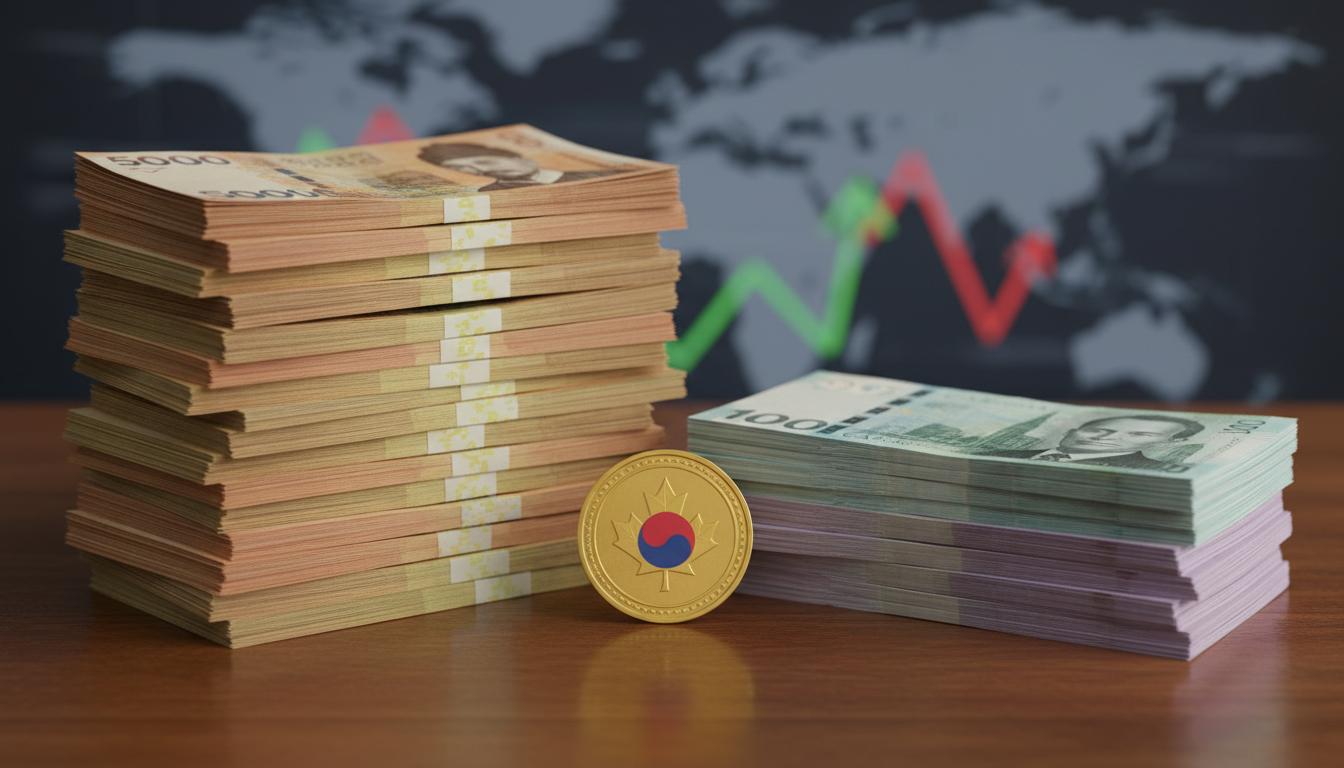
If you’ve searched “won to CAD” because you’re planning a trip to Seoul, sending money to family, paying tuition, or pricing an import deal, you’re in the right place. This guide walks you through how the South Korean won (KRW) converts to the Canadian dollar (CAD), what actually drives the KRW/CAD exchange rate, which methods are cheapest, and how to avoid the quiet fees that can chew up your budget. You’ll learn practical, step-by-step strategies for getting more Canadian dollars for your won—without guesswork, and with clear, Canadian-focused advice.
We’ll unpack how banks set rates, why card networks rarely match “Google rates,” how to read a KRW/CAD quote correctly, and when a cross-rate through USD makes sense. You’ll also find real-life scenarios: exchanging cash in Toronto or Vancouver, using online money transfer services from Montreal, choosing the right card for a trip to Busan, or hedging currency risk as a Calgary importer. Let’s turn the moving pieces of currency conversion into a plan that works for you.
KRW and CAD 101: What You’re Actually Converting
The South Korean won uses the symbol ₩ and the ISO code KRW. It’s the legal tender of the Republic of Korea (South Korea), not to be confused with North Korea’s separate currency (KPW), which isn’t used in everyday international transactions. Canadian dollars use the symbol $ and the ISO code CAD. In global markets, you’ll see pairs like KRW/CAD or CAD/KRW that show the relationship between the two.
In cash, South Korean banknotes commonly come in ₩1,000, ₩5,000, ₩10,000, and ₩50,000 denominations, with coins of ₩10, ₩50, ₩100, and ₩500. Canada uses polymer banknotes of $5, $10, $20, $50, and $100, plus coins down to 5 cents. For quick mental math, many travellers remember that ₩1,000 is roughly around $1 CAD in recent years—but that’s a ballpark, not a promise. The exact won to CAD conversion moves continuously with the market.
If you’re looking at an online rate, you’re usually seeing the “mid-market” or “interbank” rate—effectively the midpoint between the price banks buy and sell at. Retail customers don’t get that exact rate. Banks and money services add a spread to cover costs and profit, and they may charge explicit fees on top.
How the Won to CAD Rate Is Quoted—and How to Read It
Quotes can be confusing because different sources display them in different directions. Here are the common ways you’ll see KRW and CAD paired, and how to interpret them:
- KRW/CAD = X: How many Canadian dollars one won buys. Example: KRW/CAD = 0.00104 means ₩1 buys about $0.00104 CAD.
- CAD/KRW = Y: How many won one Canadian dollar buys. Example: CAD/KRW = 960 means $1 CAD buys ₩960.
Retail exchanges in Canada often show “We buy/sell KRW” with two prices. “We buy” (from you) is what they pay when you bring in won; “We sell” (to you) is what they charge when you want to buy won. The gap is their spread. Card networks (Visa, Mastercard) use wholesale rates that float daily and are usually closer to the mid-market, but your bank may add its own foreign transaction fee.
Formula: Converting KRW to CAD
When the quote is CAD/KRW (how much won per $1 CAD):
- CAD amount = KRW amount ÷ (CAD/KRW rate)
If the quote is KRW/CAD (how much CAD per ₩1):
- CAD amount = KRW amount × (KRW/CAD rate)
If fees or spreads apply, use the provider’s final rate, not the mid-market rate. That “effective rate” is what matters for your wallet.
What If You Only See USD Quotes? Using a Cross-Rate
Some platforms don’t list KRW/CAD directly. In that case, you can compute a cross-rate using USD (the world’s most liquid currency):
- KRW/USD = A (won per US dollar)
- USD/CAD = B (Canadian dollars per US dollar)
- Then CAD/KRW ≈ (KRW/USD) ÷ (USD/CAD)
That gives you a directional idea of the KRW to CAD rate. Your provider will still have its own retail pricing, but this approach helps you sanity-check any quote you’re given.
Why the KRW/CAD Rate Moves: The Big Drivers Canadians Should Watch
Exchange rates move for a mix of economic fundamentals and market sentiment. If you’re trying to time a large conversion—say, tuition or a business payment—it helps to understand the usual suspects that push KRW/CAD around.
First, interest rates. When the Bank of Canada (BoC) adjusts its policy rate, the Canadian dollar often reacts as investors reprice yields on CAD-denominated assets. Same story in Korea with the Bank of Korea (BOK). Rising Canadian rates can lift CAD relative to KRW, and vice versa. The key isn’t the rate in isolation, but whether the move was expected and what it signals about the next six to twelve months.
Second, commodities and tech cycles. Canada’s currency tends to track commodity swings, especially oil and base metals. Korea’s economy is deeply export-driven and tied to technology hardware—think semiconductors, displays, and electronics. A strong global tech upswing can support the won; a commodity rally often helps the Canadian dollar; when risk appetite sours globally, both can weaken against USD, with the cross between them sometimes moving less dramatically.
Third, global risk sentiment. In market stress (pandemics, financial crises), investors typically run to liquidity, strengthening the US dollar and often denting both KRW and CAD. That can shuffle the KRW/CAD cross in unpredictable ways in the short run. Over longer stretches, macro fundamentals reassert themselves.
Finally, trade flows and current accounts. Canadian imports from Korea (autos, electronics, industrial components) and Korean demand for Canadian goods (resources, agriculture) shape FX hedging flows. Large corporate hedges don’t show up in your day-to-day experience, but they influence wholesale pricing that trickles down to retail.
Where Canadians Actually Convert Won to CAD (and What It Really Costs)
You’ve got choices: banks, online money transfer companies, currency exchange bureaus, card networks, and ATMs. None are “best” for every situation. The winner depends on whether you’re moving money account-to-account, buying or selling physical cash, or paying by card abroad.
Canadian Banks
Major banks (RBC, TD, Scotiabank, BMO, CIBC) can convert KRW to CAD through branch services, online wires, or card transactions. They offer reliability, established customer support, and familiarity with compliance. For cash, not every branch stocks South Korean won; call ahead in cities like Toronto, Vancouver, Calgary, Edmonton, Montreal, and Ottawa. Expect to order KRW in advance, or sell back won after your trip with some delay while the branch confirms authenticity and availability.
Costs: Banks typically build a spread into the exchange rate. For over-the-counter cash conversions, spreads of 2%–6% aren’t unusual. For international wires, you may face a transfer fee plus an FX spread—and sometimes “correspondent bank” fees if the wire routes through an intermediary. For card purchases abroad, expect your issuer’s foreign transaction fee (often around 2.5% in Canada) unless you carry a no-foreign-transaction-fee card, on top of the card network’s wholesale rate.
Online Money Transfer Services
Specialized providers (for example, Wise, Remitly, OFX, XE, WorldRemit) send money from a Canadian account to a recipient in Korea. Many show the “mid-market” rate and charge a transparent fee; others add a margin to the rate and advertise low or zero fees. Compare the total you pay and the total the recipient gets in won or CAD—ignore the marketing on individual fees and focus on the all-in outcome.
Advantages: Competitive pricing versus many banks, clear tracking, speed options (economy vs express), and easy onboarding from anywhere in Canada. Limits and verification requirements vary by provider and by amount, and you’ll go through standard Canadian anti-money laundering (AML) checks under FINTRAC rules. Always check whether the recipient wants KRW or a foreign currency account in Korea; the receiving bank’s conversion can add another spread if the funds arrive in a currency the account doesn’t hold.
Currency Exchange Bureaus
Brick-and-mortar bureaus in downtown cores and near transit hubs (e.g., Toronto’s Koreatown, North York; Vancouver’s Robson or Granville areas; Calgary’s downtown; Montreal’s Shaughnessy or downtown financial district) often post competitive cash rates and can beat big-bank spreads, particularly for popular travel currencies. For KRW, pricing and stock vary; call to confirm. Airport kiosks are notorious for wide spreads—convenient, yes, but expensive. If you must use an airport counter, exchange only a small amount and settle the rest in the city.
Tip: Ask the bureau for the exact “we buy KRW” rate, and whether fees are included. Some quote an attractive rate but tack on a per-transaction charge. Walk away if the numbers get fuzzy.
Debit/Credit Cards and ATMs (When You’re in Korea)
Paying by card in Korea can be efficient. Visa and Mastercard are widely accepted, and contactless is common. The network rate tends to be close to the interbank rate, but your Canadian card issuer may add that 2–3% foreign transaction surcharge unless you have a card that waives it. ATMs at major banks (e.g., KB Kookmin, Shinhan, Woori, Hana) generally work with international cards; smaller ATMs may not.
Two important tips: First, always choose to be charged in the local currency (KRW) if a terminal offers “pay in CAD.” That prompt is called dynamic currency conversion (DCC), and it usually comes with a painful markup. Second, your bank may charge a flat international ATM fee plus a percentage; Korean ATMs can also have a local fee. The combined cost can exceed what you’d pay with a good travel card or by withdrawing larger, less frequent amounts.
Crypto or Workarounds? Think Twice
Some people consider moving funds through cryptocurrency to avoid bank fees. It’s not a stable or predictable path: crypto prices are volatile, you’ll likely face conversion costs at both ends, and compliance risks are real. For most Canadians, established regulated channels are safer, clearer, and often cheaper once all frictions are tallied.
The Hidden Fees That Matter More Than the Sticker Price
When comparing won to CAD services, isolate the “effective exchange rate” you’re truly getting. That’s your bottom line, and it includes all the following:
- FX spread: The difference between the provider’s rate and the mid-market rate at that moment.
- Transfer fee: A flat or percentage fee for sending money (often tiered by speed).
- Receiving and intermediary fees: Some Korean banks charge to receive wires; intermediaries in the SWIFT chain can deduct along the way.
- Card surcharges: Issuer foreign transaction fees (commonly ~2.5%) and cash advance fees if you use a credit card for ATM withdrawals.
- DCC markups: If a POS terminal or ATM offers conversion to CAD “for convenience,” decline it.
To compare apples to apples, note the amount you send (in CAD or KRW), every fee listed, and the final amount received. The provider that delivers the most CAD for your won (or the most won for your CAD), net of everything, wins.
Step-by-Step Examples: Converting KRW to CAD With Clear Math
Let’s walk through a few scenarios using a hypothetical mid-market example. These are not live rates; they’re to show you the mechanics. Always check a reputable rate source when you’re actually converting.
Assume a mid-market rate of 1 CAD = 965 KRW (i.e., CAD/KRW = 965 and KRW/CAD ≈ 0.00103627). Now see how different providers change the effective rate.
Example 1: Selling ₩500,000 in Canada at a Currency Exchange
Mid-market benchmark: ₩500,000 ÷ 965 ≈ $518.13 CAD (before any spreads/fees). Suppose the bureau advertises a “we buy” rate of CAD/KRW = 995 (a spread from mid). Your CAD received becomes:
- $ CAD = 500,000 ÷ 995 ≈ $502.51
If there’s also a $5 service fee, your actual proceeds drop to $497.51. Your effective rate is 500,000 ÷ 497.51 ≈ 1,004 KRW per CAD (worse than 965), equivalent to a spread of roughly 4% from the mid-market reference—not outrageous for cash, but noticeable.
Example 2: Receiving a KRW Wire From Korea Into Your Canadian Bank
A friend in Seoul sends ₩3,000,000. Your Canadian bank converts it upon receipt. The bank shows CAD/KRW = 1,010. Your deposit is:
- $ CAD = 3,000,000 ÷ 1,010 ≈ $2,970.30
If the mid-market cross suggests $3,108.81 and the bank also charges a $15 incoming wire fee, your net is $2,955.30, meaning the total spread and fees cost you over $150 on this transfer. An online provider that converts closer to the mid-market with a transparent fee might deliver more to your account, even after its fee.
Example 3: Paying by Canadian Credit Card in Korea
You spend ₩120,000 on dinner in Seoul. Visa’s wholesale rate that day implies CAD/KRW = 968. Your issuer adds a 2.5% foreign transaction fee. Your bill in CAD is:
- Base: 120,000 ÷ 968 ≈ $124.00
- Plus 2.5% = $127.10
If the restaurant offered to charge you in CAD at an in-terminal rate of CAD/KRW = 900 via DCC, that same dinner would post as 120,000 ÷ 900 ≈ $133.33, before your issuer’s foreign fee. Choosing local currency (KRW) usually wins.
Quick Reference: Common Won to CAD Conversions at a Hypothetical Mid-Market Rate
| KRW | Approx. CAD at 1 CAD = 965 KRW |
|---|---|
| ₩10,000 | ≈ $10.36 |
| ₩50,000 | ≈ $51.81 |
| ₩100,000 | ≈ $103.63 |
| ₩500,000 | ≈ $518.13 |
| ₩1,000,000 | ≈ $1,036.27 |
| ₩5,000,000 | ≈ $5,181.35 |
Again, those are illustrations. Your real result depends on the live rate and your provider’s pricing.
Real-World Playbooks for Canadians
Abstract tips are fine, but you need moves you can actually make. Here are tailored strategies for common Canadian scenarios involving KRW to CAD (and CAD to KRW).
1) Travelling From Canada to Korea
Before you fly, buy a small amount of KRW for day-one expenses and airport transit. In major Canadian cities, shop around at two or three currency exchange bureaus and compare total costs to your bank’s offer. Don’t stress about getting the absolute best rate on a tiny starter amount; you’ll have better options in the city than at the airport if you need more cash.
Bring at least one no-foreign-transaction-fee card if you can, and notify your bank you’ll be abroad. In Korea, withdraw cash in moderate lump sums from bank ATMs to minimize per-withdrawal fees, and pay by card where it’s accepted. Decline any offer to pay in Canadian dollars at the terminal. Keep a T-money transit card for subways and buses; you can load it with KRW at machines with English instructions.
2) Visiting Canada With Won in Your Pocket
If you’re arriving in Vancouver, Toronto, Calgary, or Montreal with KRW and need Canadian dollars, don’t exchange all your cash at the airport unless you have no alternative. In the city, check two or three bureaus’ “we buy KRW” rates. If you have a Korean debit card that waives or reduces international fees, try a Canadian bank ATM, but know that your home bank and the ATM operator can both charge. As a backup, major Canadian banks can buy your won, but call the branch first to confirm they handle KRW cash and ask for the complete rate, including fees.
3) Paying Korean Tuition or Supporting Family From Canada
For recurring transfers, compare several online money transfer providers and your bank. Look at:
- The posted KRW/CAD or CAD/KRW rate versus mid-market at that moment.
- Transfer fees and speed tiers.
- Receiving bank fees in Korea (ask the recipient’s bank).
- Whether the receiver prefers KRW or a foreign currency account.
Use rate alerts to catch favourable moves. If you’re sending large amounts, some services let you lock in a rate for a period or place a market order (send only if the rate hits your target). Keep records of amounts, dates, and rates for your files. You’ll pass standard Canadian KYC checks (ID, source of funds as needed) under FINTRAC rules. This is normal and protects both you and the system.
4) Importing From Korea as a Canadian Small Business
Price your inventory using conservative exchange rates, not the best number you saw last week. Build a cushion for FX volatility. For regular imports, talk to your bank or a specialist about hedging tools:
- Forwards: Lock in a KRW/CAD rate for delivery in the future. You’ll know your CAD cost today for a shipment arriving next quarter.
- Options: Pay a premium to cap your FX risk while keeping upside if the rate moves in your favour.
- NDFs (non-deliverable forwards): Common in KRW markets for institutions; your bank or FX provider can advise whether this fits your size and needs.
When goods cross into Canada, remember that GST/HST and any duties are assessed in CAD based on the customs value. The Canada Border Services Agency (CBSA) uses designated exchange rates it publishes (derived from Bank of Canada data) for valuation, which can differ from your bank’s settlement rate. Coordinate with your customs broker to avoid surprises on landed costs.
5) Online Shopping and Subscriptions Across Borders
Buying Korean goods online? If you pay in KRW, your card issuer’s foreign transaction fee applies unless waived. If a checkout page offers to bill you in CAD at its own rate, compare carefully—DCC on e-commerce can be pricier than your card’s normal conversion. For subscriptions (streaming, education, software) billed in KRW, consider a no-foreign-fee card to trim the ongoing drip of FX costs.
Compliance, Security, and Canadian Rules You Should Know
Currency conversion doesn’t happen in a vacuum. Canada has clear rules designed to keep transfers safe and transparent. Knowing the basics will save you hassle.
FINTRAC and Money Services Businesses (MSBs)
In Canada, banks and registered money services businesses report to the Financial Transactions and Reports Analysis Centre of Canada (FINTRAC). When you open an account or send funds, you’ll provide ID and, for larger or unusual transfers, you may be asked for documents showing source of funds or purpose (e.g., invoice, tuition letter). This is standard AML compliance and doesn’t mean you’re in trouble. Choose providers that are registered and transparent; you can search FINTRAC’s MSB registry online.
Bringing Cash Across the Canadian Border
You can bring any amount of cash or monetary instruments into or out of Canada, but if the total is CAD 10,000 or more (or equivalent in a foreign currency), you must report it to CBSA when you enter or leave. This includes cash, bank drafts, travellers’ cheques, and certain prepaid instruments. If you forget to declare, you can face penalties and seizure. If you’re travelling with family, the threshold applies to the combined total you’re carrying. Forms and guidance are available from the CBSA; declarations can be completed at the port of entry or online in some cases.
Taxes and Recordkeeping
For everyday travel cash, most Canadians don’t run into tax issues. If you hold foreign currency for business or investment reasons, there can be taxable gains or losses when you convert back to CAD. The Canada Revenue Agency expects you to keep records of significant foreign exchange transactions, including dates, amounts, and rates used. When in doubt—especially for large or repeated transactions—speak to a Canadian tax professional to ensure you’re handling reporting correctly under current CRA guidance.
Timing the Market vs. Having a Plan
Everyone wants the best rate, but trying to call short-term tops and bottoms is a coin flip. A smarter approach for most Canadians is to manage risk and friction:
- Use alerts to pounce when KRW/CAD hits a target you like.
- Split big conversions into tranches over days or weeks to reduce timing risk.
- Lock rates for known future payments (tuition, inventory) using forwards or scheduled transfers.
- Eliminate avoidable fees: no-foreign-fee cards, declining DCC, and comparing providers.
If you’re a business with thin margins, don’t leave currency as an afterthought. Bake your hedging policy into purchasing and pricing. Even simple rules—like locking 50% of next quarter’s KRW purchases at today’s rate—beat scrambling when markets whip around.
City-by-City Notes in Canada
Availability and pricing for KRW cash can vary by region. Here are some practical notes:
Toronto and the GTA: You’ll find multiple currency exchanges downtown, in Koreatown (Bloor Street West), North York, and around major malls. Call two or three for a quote before heading out. Large bank branches can order KRW; plan 1–3 business days.
Vancouver and the Lower Mainland: Look in downtown corridors and Richmond. Rates can be competitive due to high travel volumes. Airport counters at YVR are convenient but pricier; exchange a small amount there if needed and do the rest in the city.
Montreal: Downtown exchanges around Sainte-Catherine and Peel offer reasonable options; availability of KRW is decent but call ahead. If you bank with a national institution, your branch can typically assist with orders.
Calgary and Edmonton: Fewer players than Toronto/Vancouver, but you’ll still find independent exchanges downtown and near shopping districts. With banks, expect to order KRW in advance.
Ottawa, Winnipeg, Halifax and others: Banks can place currency orders on request; independent exchanges exist but may have limited KRW stock. Check spreads carefully on less-common currencies and consider whether card and ATM strategies abroad might be more efficient.
Provider Comparison: What to Look For When Converting Won to CAD
Use this checklist to evaluate your options. Don’t just default to the first familiar name—prices vary more than you think.
| Channel | Best For | Pros | Cons | What to Check |
|---|---|---|---|---|
| Major Canadian Banks | Reliability, large wires, in-branch service | Trusted, integrated with your accounts, wire capabilities | Wider spreads, transfer and receiving fees, slower cash availability | Total cost (rate + fees), estimated arrival time, KRW cash availability |
| Online Money Transfer Services | Account-to-account transfers to/from Korea | Competitive rates, transparent fees, fast options | Verification steps, transfer limits, receiving bank fees | All-in rate, payout options (KRW vs FX account), speed tiers |
| Currency Exchange Bureaus | Travel cash buys/sells | Often better cash rates than banks, immediate settlement | Airports expensive, KRW stock varies, safety of carrying cash | “We buy”/“we sell” rates, any per-transaction fee, authenticity checks |
| Debit/Credit Cards | Everyday spending abroad, small purchases | Convenient, network rates close to wholesale, purchase protections | Issuer foreign transaction fee unless waived, ATM fees for cash | Whether your card waives FX fees, network rate estimates, DCC prompts |
Simple Mental Math for KRW to CAD on the Go
When you’re standing in a Seoul street market, you don’t have time for spreadsheets. Use a rough rule of thumb for quick sense checks. If the live market has 1 CAD ≈ 950–1,000 KRW, then:
- ₩10,000 ≈ $10–$10.50 CAD
- ₩50,000 ≈ $50–$53 CAD
- ₩100,000 ≈ $100–$105 CAD
Then adjust for your situation: your card’s FX fee, an ATM fee, or a bureau’s spread. You won’t be exact, but you’ll know whether you’re in the right ballpark or getting a raw deal.
Common Mistakes Canadians Make with KRW/CAD—and How to Avoid Them
Even savvy travellers and business owners get tripped up. Learn from others’ pain points:
- Letting DCC choose for you: Always pay in KRW in Korea and in CAD in Canada.
- Ignoring spreads: A “no fee” banner can hide a worse rate. Compare the effective rate.
- Exchanging too much at the airport: Convenience has a cost. Use it only for small amounts.
- Forgetting receiving fees: Ask the Korean bank if incoming wires incur charges or forced conversions.
- Not planning for customs valuation: Your landed cost may use CBSA’s designated rate, not your bank’s.
- Over-timing small amounts: Don’t waste days chasing pennies. Focus on big-ticket conversions.
- Carrying large undeclared cash: Over CAD 10,000 or equivalent must be reported when crossing Canadian borders.
KRW/CAD History in Brief: Why Today’s Rate Isn’t Random
While day-to-day moves feel noisy, broader themes matter. Korea’s economy transformed into a high-tech export powerhouse; its currency responds to global cycles in electronics and demand from major trading partners. Canada’s dollar, meanwhile, reflects commodity cycles and interest rate differentials with the United States. In stress periods like the Asian financial crisis of the late 1990s or the global financial crisis of 2008, KRW moved sharply, while CAD also reacted to oil and global risk aversion. The pandemic shock and the strong-USD cycle in 2022 reminded everyone that USD often dominates when fear spikes. Understanding those forces won’t give you perfect timing, but it will help you set realistic expectations for volatility around KRW to CAD conversions.
Glossary: Quick Definitions You’ll Actually Use
- Mid-market rate: The midpoint between wholesale buy and sell prices in the interbank market. What you see on financial sites.
- Spread: The provider’s margin built into the exchange rate.
- DCC (Dynamic Currency Conversion): A merchant or ATM offers to convert a foreign purchase into your home currency at its own rate, usually worse.
- Forward contract: An agreement to exchange currencies at a fixed rate on a future date.
- NDF (Non-Deliverable Forward): A forward contract settled in a convertible currency (often USD) referencing a non-deliverable currency like KRW in institutional markets.
- SWIFT: The international messaging network banks use for cross-border transfers.
- FINTRAC: Canada’s financial intelligence unit overseeing AML compliance for banks and MSBs.
Frequently Asked Questions About Converting Won to CAD
What’s the best way to convert won to CAD in Canada?
For physical cash, compare two or three city-centre exchange bureaus and your bank’s rate; airports are a last resort. For account-to-account transfers, compare your bank with reputable online money transfer companies and pick the best all-in rate and speed. For everyday spending in Korea, a no-foreign-fee credit card plus occasional ATM withdrawals usually beats cash exchanges.
Is it better to pay in KRW or CAD when I’m in South Korea?
Pay in KRW. If a terminal offers to charge you in CAD, decline. That’s dynamic currency conversion, and the rate is typically worse than your card network’s rate—even if your card has a foreign transaction fee.
How do I get the live KRW to CAD rate?
Check a reliable source that shows the mid-market rate (many financial sites and apps do). Then compare it with your provider’s quoted rate at the same time. The difference is their spread. If fees apply, add them to see your true, effective rate.
Do Canadian banks buy and sell Korean won cash?
Many do, but not all branches keep KRW on hand. In Toronto, Vancouver, and Montreal you’ll have better luck. Call ahead to confirm availability, timing, and the exact “we buy” or “we sell” rate. Bring valid ID.
What fees should I expect when wiring money between Canada and Korea?
Expect a transfer fee from the sender’s provider, an exchange rate spread, and possibly a fee from the recipient’s bank. If the wire passes through an intermediary (correspondent bank), an additional deduction can occur. Ask both the sending and receiving institutions about all potential charges.
Is it safe to use online money transfer services for KRW/CAD?
Choose reputable providers operating in Canada and registered with FINTRAC as MSBs. They use bank-grade security and standard AML checks. Read reviews, confirm fees and rates, and verify customer support options. For large amounts, consider a test transfer first.
How much cash can I bring into Canada?
Any amount, but if it’s CAD 10,000 or more (or equivalent in another currency), you must declare it to CBSA when you enter or leave Canada. Failure to declare can lead to penalties and seizure. Declaring is straightforward and legal.
Are foreign exchange gains taxable in Canada?
For everyday personal travel cash, tax isn’t typically an issue. For business or investment purposes, foreign exchange gains and losses can be taxable. Keep records and consult a Canadian tax professional for your situation and the latest CRA guidance.
When is the best time to convert KRW to CAD?
No one can predict with certainty. Watch central bank announcements, major economic data, and market sentiment. For large, time-sensitive payments, consider locking a rate or splitting the transfer into parts to reduce timing risk.
Should I use USD as a bridge to convert KRW to CAD?
You can estimate cross-rates via USD to sanity-check pricing, but you don’t need to manually convert twice. Most banks and transfer services can quote KRW/CAD directly. If a path through USD happens behind the scenes, they’ll handle it.
Do Korean ATMs work with Canadian debit cards?
Major bank ATMs in Korea generally accept foreign cards on networks like Plus and Cirrus. Fees vary. Your Canadian bank might charge an international ATM fee and a percentage; the Korean ATM can add a local fee. Withdraw larger amounts less often to cut per-transaction costs, and always choose to be charged in KRW.
Is the “Google rate” the rate I’ll actually get?
Usually not. Search engines show the mid-market rate. Your bank or provider adds a spread and may charge fees. Use the mid-market rate as a benchmark to evaluate offers, not as an expectation of what you’ll receive.
Can I hedge KRW/CAD exposure as a small business in Canada?
Yes. Talk to your bank or a currency specialist about forwards, options, or structured solutions sized to your flows. Even a simple forward that locks your next shipment’s rate can stabilize margins. Confirm credit requirements and collateral terms before you commit.
What’s the easiest mental shortcut for won to CAD?
When 1 CAD sits near 950–1,000 KRW, think of ₩10,000 as roughly $10–$10.50 CAD. Then layer in known fees for your method (card FX fee, ATM fee, or bureau spread) to get close enough for quick decisions.
Are there differences between KRW cash and electronic transfers for rate quality?
Yes. Cash conversions usually have wider spreads than electronic transfers. Money transfer services and card networks tend to be closer to mid-market than airport cash counters. Always compare the net result for your specific amount.
Bottom Line: Make “Won to CAD” Work for You
Converting South Korean won to Canadian dollars doesn’t have to be a guessing game. Decide whether you need cash, an account transfer, or card-based spending. Compare the all-in rate, not just the headline fee. Dodge traps like DCC and airport-only exchanges. For significant sums, use alerts, split timing, or lock a rate. And keep Canadian rules in mind: FINTRAC compliance checks are normal, and cash over CAD 10,000 must be declared at the border.
Do that, and you’ll keep more value in your pocket—whether you’re swapping KRW for CAD in downtown Toronto, sending tuition from Vancouver to Seoul, or pricing a container of parts in Calgary. The mechanics are simple. The difference is discipline.